Search

Showing posts with label Neil Gaiman. Show all posts

Sunday, July 1, 2018

the where of Neverwhere.

During what was an acceptably charming BBC miniseries in 1996, author Neil Gaiman kept a notebook with him, wherein he decided that all the efforts happening on behalf of his commissioned screenplay deserved a matching novel, and so he wrote Neverwhere.


With the property also being adapted into a graphic novel & BBC radio drama, some half-born rumors that it's going to be movied for the big screen, and Gaiman's announcement in February last year of an in-progress sequel book, such narrative endurance again proves Gaiman is one of our foremost our modern mythographers.


Neverwhere taps into the persistent idea that there's another more fascinating reality below the conscious universe that reflects our unconscious in all its imagination and desire, beneath the skin and bone, the thought under the thought. It's the truth behind that nagging feeling of the apparent world versus the essential.


[Tucked to the side of a vagrant haunted Tucson underpass, this installation was enchanted by a sinister elder-styled script with the key "The Door Opens Inward". Photo credit to myself during a dog walk one very dark night.]


Preceeding Neverwhere in this city below concept is Arthur Machen's The London Adventure (citations from the 1924 Knopf hardback):


"... and that fancy is infinitely more impress than fact, partaking, as it does, not of actuality but reality." p.48 


"But I think something happened; that the doors were opened; that the human spirit came into momentary contact with worlds which it is not meant to visit." p.82-83 


"Strangeness which is the essence of beauty is the essence of truth, and the essence of the world. I have often felt that; when the ascent of a long hill brought me to the summit of an undiscovered height in London; and I looked down on a new land." p.152


Like a master storyteller, it's Gaiman's oh-so-proper English style and completely in-passing delivery that gives the tale its voice. It comes off so easy & winning, which is a testament to the forethought and craft behind the work. The following citations from the pagination of the first U.S. edition hardback prove this:


"He continued, slowly, by a process of osmosis and white knowledge (which is like white noise, only more useful), to comprehend the city". p.9 


"A click: the sound of a switchblade opening, empty and lonely and dark." p.19 


"She looked at him rather sadly, like a mother trying to explain to an infant that yes this flame was hot, too. All flames were hot. Trust her, please." p.75


"Then he flexed his fingers, put the pennywhistle to his lips, and began to play an odd, rollicking tune that leapt and twisted and sang. It made Richard feel as if he were thirteen years old again, listening to the Top Twenty on his best friend's transistor radio at school during lunch hour, back when pop music had mattered as it only can in your early teenage years: the marquis's reel was everything he had ever wanted to hear in a song ..." p.125 


"But now, in her dream, that is not happening. Instead, the weasel is reaching out a forepaw toward her, and she is dropping her throwing stick and taking its paw. And then and there, in the undercity beneath Bangkok, they are dancing together, in one intricate unending dance: and Hunter is watching from outside herself, and she is admiring the elaborate movements they make as they move, tail and legs and arms and fingers and eyes and hair all tumbling and twisting powerfully and strangely into the underneath and out across forever." p.192 


"'How old are you?' asked Door. Richard was pleased she had asked; he never would have dared. 'As old as my tongue,' said Hunter, primly, 'and a little older than my teeth.'" p.201


[The Chair of Mysteries sits at the end of a street. One feels as if someone might materialize there when the planes shift and the worlds touch. Found & photographed by myself during another fearless dog walk into a neighborhood no one should live in.]


Recently I had the pleasure of attending the Tucson Steampunk Society's book club meeting for this urban fantasy favourite, which only liminally has some shared subgenre points with steampunk. I hadn't expected it to be livecast & recorded, but I'm glad the TSS got to show off its literary taste & acumen, myself included.


Watch it here.


I enter off camera at 47:37, get asked about my social credentials & am begged to runway model walk my Dark Librarian apron for the Monster Rangers at 51:00, cite the book's most intense moment 1:00:49 with a clever roller-coaster metaphor, orate my perception of the use of mythic time and parallel ideas at 1:16:11, and questioned if would I go to London Below at 1:19:16, which is yes, obviously.


Looking forward to The Seven Sisters, wherein the tale of Neverwhere is continued. 


[TSS is doing Neal Stephenson's The Diamond Age next month, so if you've got serious brilliances to say about this Nanopunk original, do come.]


             #   #   #


11/2018 Addenda: The above pictures have since changed. The Chair of Mysteries has left its nexus point and is missing, and the City of Tucson has misguidedly used our tax dollars to paint over "The Door Opens Inward" label but not the actual graffiti in that same underpass. 


#   #   #


While a mostly happy bookstore fixture for over two decades, Guillermo Maytorena IV is currently willing to entertain your serious proposals for employment as a literary/cinema critic, goth journalist, castellan, airship pilot/crewperson, investigative mythologist, or assisting in a craft brewery. Should you be connected to any of the above or equally interesting endeavours, do contact him via LinkedIn or G+.


Friday, March 17, 2017

NorsePlay: Neil Gaiman's "Norse Mythology".

Neil Gaiman faced the daunting task to adapt the narrative holy of the holies, the ur-book stories, the most ancient tales known to man from which all other tales have since flowed from: Norse Mythology.


As we told a childhood friend of Neil's last month, Neil is a fearless writer, that before Neil there wasn't a great movement in the fantasy genre to use the Gods as actual intimate first & close third-person protagonists.


[Neil Gaiman being fearless!]

We look back at his record for this daring talent with reading pleasure: The Sandman (his breakout World Fantasy Award-winning graphic novel series expanding the being of Greek deity Morpheus), American Gods (heavily featuring Gods from various pantheons), and Odd & the Frost Giants (a NorsePlay story for children of all ages). And now, in a tribute to pay back what originally inspired him, Gaiman offers us his version of Norse Mythology.


In his introduction, Neil points out and mourns the loss of many stories in the Norse Lore, with only hints of more left behind in epithets and kennings:


I wish I could retell the tales of Eir, because she was the doctor of the gods, of Lofn, the comforter, who was a Norse goddess of marriages, or of Sjofn, a goddess of love. Not to mention Vor, goddess of wisdom. I can imagine stories, but I cannot tell their tales. (p.14)


You big tease, Mr. Gaiman, as we're pretty sure you could draft some. (And go check out "The Almighty Johnsons" for an interesting take on these goddesses.)


One can't help but hear Gaiman's comfortable English accent while reading. (If you're unfamiliar, listen to this.) Some authors make a total hash of reading their own work (talking to you, departed Douglas Adams), but the words here just rise off the page as though you're listening by a campfire. 


The bar for comparison will always be D'Aulaires' Norse Gods & Giants, but Gaiman instead grew up with Roger Lancelyn Green's Myths of the Norsemen. This early inspiration aside, he sources Snorri Sturluson, the Poetic Edda, and Rudolf Simek's Dictionary of Norse Mythology for his current retelling.


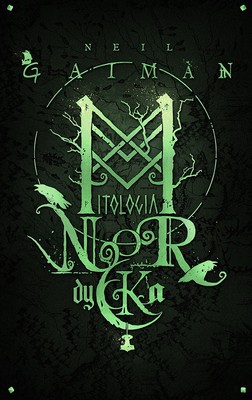
[Fenrir-fraught German edition cover.]

There's an open-endedness to the Norse Lore which allows the teller to detail in the blanks as they see fit. Everyone takes the opportunity to do so, and in this Gaiman is no different. Just when you thought you'd heard all the names for the Gods, he comes up with some original epithets, which is a skaldic achievement.


Charming anachronisms, born of Gaiman's penchant for contemporary urban fantasy (i.e. Neverwhere), make their way into his version of the Eddaic material. For instance, the giant that survives Ymir's flood of lifeblood does so by "clamoring onto a wooden box" (p.32), and smithy dwarf Brokk threatens Loki with converting his head into "A thinking machine (...) Or an inkwell." (p.55) The fact that these modern day items can flow backward and find a place inside these stories only reinforces the Norse Lore's timeless essence.


Other interesting additions and modifications in Gaiman's version include: the cosmic giant Ymir being made neither sex yet hermaphrodite, the detail of runes inscribed on the sides of Utgardaloki's bottomless challenge horn, the rationalization of Odin, Vili, & Ve wanting to create better worlds to live in & thus sanctioning the necessary sacrifice of Ymir to provide realm-building materials to do so, the prick of "Baldur's bell-like laughter...", a new character of Thyrm's conniving sister at Thor's marriage, and Mjölnir winning the the dwarven crafting contest because of its ability to protect, as Gaiman emphasizes that value far above the other entries.


Gaiman also specifically assigns the Vanir's Frey & Freya with the creation of Kvasir, which dovetails nicely into their role as both generative/creative gods and as the members of the post-war tribal exchange.


As the book continues, one can't help but notice Gaiman's enjoyment of writing Loki as a foil for events, especially seen in his extended embellishment of Loki's seduction of the giant's draft horse into something rather sensual.


"The Mead of Poets" is a brilliant standout. The dwarves who kill Kvasir are recast from spiteful miscreants into alchemists, which makes more sense for the murder's resultant beverage. And Bolverkr's underhanded wooing of Gunnlod's done as well as any modern lothario running game on a girl on any given club night.


"Hymir and Thor's Fishing Expedition" partly gets retold as a bad stepfather story, as Tyr's giantess mother marries the abusive & inhospitable Hymir, and we get a taste of Tyr's oppressive early home life.


Hel's half-dead side is descibed as looking into the "pale eye of a corpse" (the exact phrase Gaiman re-uses later for midwinter's brief and distant sun). Gaiman's previous empathetic personification of Death in Sandman may have been partly influenced by her Gothic-forbearer Hel:


"I am only myself, Hel, daughter of Angerboda and of Loki," she said. "And I like the dead best of all. They are simple things, and they talk to me with respect. The living look at me with revulsion."

One can't help but admire Hel's forthright manner, and despite the horror of her condition, she wins us with her self-acceptance, and also wins Odin when he gives her a fitting place in his cosmic scheme of things.


Gaiman reorders events to make more narrative sense. Odin raises the long dead wise woman völva only once, far later in the stories after Balder experiences his plague of nightmares. Gaiman also takes the liberty of making the völva Loki's lover & monster mother jötunness Angrboda, which makes her belligerent & doom-filled revelations to Odin more motivated. This shuffling of prophecy toward the end of things gives the reader a feeling that Ragnarök's too late to stop by the time Odin hears of it, which eliminates the usual planning versus destiny questions of why can't it be avoided if the Gods know about it from so early on in the stories' throughline.


[Hungarian edition.]

Like in Sandman, and in his introduction, Gaiman falls prey to the common slanderous reduction of Thor to a box of hammers ... which ignores Thor's verbally deft outwitting of dwaven Alvíss (actually meaning "All-Wise") to save his daughter Thrud from his amorous attentions, and Gaiman omits this story in his collection. 


A huge deviation in "The Story of Gerd and Frey" is that Gerd's refusal of Frey's proposal is completely skipped. One wonders if the coercion aspect was found to be distasteful by the author, but that's negated anyhow for most modern audiences by her finding mutual happiness with Frey at the end. He is a God of love after all, and being selected by love itself for marriage would be the ultimate compliment.


A serious missed-opportunity occurs in "The Last Days of Loki" when the "Lokasenna" usually takes place. During this episode Loki calls out all the Gods on their transgressions and shortcomings in an attempt to show them they're as mischievous as he is and hypocritical to boot (which is false since Loki's brand of mischief also harms everyone and is born of a darker motivation). Unlike Gaiman's previous writerly use of Loki, he skips the potential of this famous verbal tennis match entirely, which we found disappointing.


[Domestic cover with nordic landscaping.]

During "Ragnarok: The Final Destiny of the Gods", there's a dying exchange between Heimdall & Loki, and a gorgeous post-Ragnarok ending that movingly capstones the book.


Bottom-line: Does Gaiman significantly improve the telling? No, but his telling is respectful, adorned with thoughtful things only he would do, crafted with the fuzzy edges of myth gathered & woven into smoother narratives, poetic yet accessible, and, in many passages, beautiful & wondrous. In that meritorious achievement, Gaiman fulfills the role of that Green version he grew up with, and this new version will be the lens through which the current generation first encounters the All-Father, the Trickster, and the Thunderer. Snorri would be proud.


#      #      #


While a mostly happy bookstore fixture for over two decades, Guillermo Maytorena IV is currently willing to entertain your serious proposals for employment as a literary/cinema critic, goth journalist, castellan, airship pilot/crewperson, investigative mythologist, or assisting in a craft brewery. Should you be connected to any of the above or equally interesting endeavours, do contact him viaLinkedIn or G+.

i miss my dead dog ... so what am i?

I fucking miss my dog. I miss him so much, my packmate, Buddy Guillermosson. And the thing is I know, I know he's having a good time, ...