Search

Showing posts with label religious reconstructionism. Show all posts

Tuesday, October 20, 2015

NorsePlay: ideas from the Odin Brotherhood.

When Professor Mark Mirabello published The Odin Brotherhood (1992) surely many dismissed the idea of a surviving secret society of religious Norse practitioners as an attractive fantasy, or thought the dialog in the book only an Edda-like delivery system for a revival.


Understandably any sort of unearthed esoteric knowledge revealed after hundreds of years using unconfirmable sources opens itself up to scrutiny & examination, especially by reconstructionists who've had to weed out and re-plant structures in their religion, and we leave it up for those better versed in the archaeology & attestations in Asatru lore to do so.


What can't be argued is that Mirabello serves up some interesting ideas & perspectives onto the Asatruar's table, which we will present & ourselves extrapolate on here from the 5th edition (we don't have the current 6th edition [but if the publisher wished to send us one, we'd be happy to examine & revise this survey in light of the additional 50 pages, and even comment on Jack Wolf's complimentary The Way of the Odin Brotherhood {2013}, if included]).


[Bifrost to Asgard backdrop in Richard Wagner’s "Das Rheingold", directed by Otto Schenk (1990).]

The gods are presented throughout the text with unheard of epithets & cognomen, so much like the lore in using metaphorical descriptors & narrative associations to speak about the Aesir, which makes for some new additions one could use in writing or ritual.


Unlike in the Eddas, where it's the death of only a few of the gods that are detailed during the cataclysmic Ragnarök, we get a very grim additional description of the deaths of Frigg & Iðunn: "Freya will slay several trolls before she herself is killed, Idun [sic] will be soiled and raped and murdered" (p.102). There always seemed to be the implication that frost giant Þjazi perhaps did more than hold the youth-giver for her apples, but here the brutality upon her is made explicit & final.


As per the Brotherhood's origin story, a lead tablet will communicate to a dead person if buried at their grave in the winter (p.17). It's the exception that the dead answer, and it was a reply that formed their secret society.


The OB claim there are three types of death that lead to three different afterlife realms: Death in battle, the straw death of old age/sickness, and death by sorcery. Death in battle is a requirement in order to psychologically face death again when Ragnarök comes. In stark contrast, death by magick is bad since that ending denies the final army better numbers, thus giving us a longterm applied reason to avoid using magick for fatalities in the first place, which the OB states is "killing with words" and used by "all who thrive on malice" (p.74). The need for battle death also makes a fitting justification for Odin's grand plan to prepare for Ragnarök.


"Some men become terrified and dizzy at great heights. According to an old legend, it is the proximity of the gods at great heights that makes people afraid." (p.50) This passing detail jibes with citations that meditations to seek clarifying visions took place on high places, much like Odin camping on high seat Hliðskjálf to gain the best perspective.


All the gods cast a "light shadow" more like a reflection, as opposed to our conventionally dark shadow; therefore they'll only visit Midgard at night so as to conceal themselves (p.33).


Time between Asgard & Midgard passes at different rates: "An instant in the reality of the gods is an epoch in the reality of men." (p.61) This temporal difference could account for divine superspeed, seeming multi-locatant, and the need for special apples to offset aging. If men enter the reality of the gods, aging occurs, a reversed principle similar to the fairyland tales where visiting/kidnapped mortals don't age, while time passes much faster back home.


As for other realms, the OB locates Alfheim "where every river begins": "Rain is where every river begins, so the Elf-World is somewhere in the architecture of the clouds" (p.67). 


Frost giants & fire giants "exist in oblique corridors" (p.43), implying a nearby plane or dimension where they lay in wait for those barriers to break down when the universe ends. Sort of Lovecraftian, yes?


Death is hands-on sexy:


"AUTHOR: From the Odinist perspective, what is death?


THE ODIN BROTHERHOOD: In poetic terms, death itself is personified as beautiful females who exist in an endless variety of exquisite forms. These females are called the valkyries.


AUTHOR: And these valkyries extinguish life?


THE ODIN BROTHERHOOD: Yes. The gentle hands of the valkyries softly and voluptuously do the work of killing." (p.71)

Well, if you're putting it like that, death is a welcome pornography.


Endtimes update: Baldur is already dead (p.82). As the forerunning prophecy for Ragnarök, this places a greater urgency on the current state of things as far as the OB see it.


The text also presents the idea of time as an eternal cycle, similar to science's oscillating cosmology theory where the universe big bangs out (like Niflheim's ice mixing with Muspelheim's fire to explode matter into being), then gravity stalls the expansion and draws it back to collapse onto itself, only to bang out again, but the gods return with every universal genesis, like the lore mentioning Baldur's return after the sturm und drang of the current world's end is finished and everything resets. 


As for fate, it is something that's already woven out for us (p.93): "We cannot choose the joys or the terrors we must face, but we can choose to face them calmly. That is our freedom." Ergo, the inevitable's going to happen, but how we deal with it makes the difference.


And finally, the OB claims that when honor & heroic action are no longer found on Midgard, the separate worlds will break down, and Ragnarök will happen. So in the very act of honouring the old gods, we stave off Ragnarök indefinitely, and that alone is reason enough to venerate the Aesir. It's in our interest & the gods' interest to blot, for these interests of preservation, celebration, and recognition are one in the same.


Whether one buys the Eddaic adornments of what the OB's secret lore says or not, they provoke us to rethink what we know, and their last and most important point reminds us that in honoring the gods, we also honor the potential for our best selves and the world around us, all in the same horn, and that alone is worth listening (and drinking) to. 


#   #   #


While a mostly happy bookstore fixture for over two decades, Guillermo Maytorena IV is currently willing to entertain your serious proposals for employment as a literary/cinema critic, goth journalist, castellan, airship pilot/crewperson, investigative mythologist, or assisting in a craft brewery. Should you be connected to any of the above or equally interesting endeavours, do contact him via LinkedIn or G+

Saturday, September 1, 2012

the arc of mythology.

Since I was seven I'd intended to read the source texts. I remember checking the Eddas out of the public library, big blue hardbacks, alternate potential bibles for living clutched to my chest as though I was the first to discover them. Compared to Catholicism with its guilt and its faceless god, his nearly passive son, and inexplicable holy spirit, the three-in-one trio of whom were content to just be self-satisfied watchers, there was an allure in distinct polytheism, a group of gods that were do-ers: lovers, warriors, sowers, movers and earthquakers, embodiments of worldly forces, involved in the lives of their creations, gifting favour to those who earned it in their lifetime.


The infinite paths of other reading led me away from that intention, finding the Eddas inaccessible to my gifted but young mind. As yet unschooled in poetry or archaic language structures found in Dante or Shakespeare, instead I started reading the staples of fantasy -- Tolkien, Leiber, Moorcock -- but still knew at root of all that high adventure, mythology was that genre's foundation, and that base would one day await me when I was ready. And while I was ready decades ago it's only now I've since walked the labyrinth, drank mead in Valhalla, witnessed geneses and apocalypti, and have much to report of unexpected disappointment, ancient wonder, and the revelations of the gods themselves in these first-hand sources.


Enuma Elish

(~7000-1100 BCE)

Possibly the earliest mythology, there's precedent of the flood, a washing away that occurs in many other myth cycles, but may very well be remembered from a flooding of the Tigris and Euphrates, or even Mediterranean tidal waves. The Elish is moreso a Babylonian story of creation and generational change that ends in fire god Marduk's victory over a more primal Tiamat, his grandmother and ancient she-dragon/water-serpent bent on revenge and destruction. Reading of sky-god Anu (Ah-nu) and company feels representational and there's alot of speculative prehistory that speaks of these deities being ancient aliens or advanced astronauts, but if it's really there it's not overtly apparent. We could possibly spend the same amount of millenia guessing what else may have been at play behind these stories, but we may never know short of finding The Tablets of Destiny hidden away somewhere next to a lightning gun and levitation harness.


The Library of Greek Mythology

(~100-200 CE)

Less a storybook and more of a primer, it's like reading a genealogy with addenda interspersed in the family lists. As a reader this was rather disappointing, though it delivered small delights for me from time to time in versions and variants of tales I'd read about before. Historically this document's priceless and lends itself to comparing with other surviving classical works, like the royal dramas of Sophocles and Aeschylus, or the Homeric epics and hymns. The Greek writers and scholars saw no difference between history and mythography. To them, it was the same, sacred as if automatically channeled from a muse, and given the overall consistent structure of the stories it may very well have been. 


Prose Edda

(~1200 CE)

The big surprise here is the recontextualization of Norse myths into classical Greek works by stating that the Aesir were descended from the house of Ilium at the beginning of the book(!). Given then-Christianity's recent ascent in Scandinavia one might imagine the author as ruler of Iceland had to cover his hind by couching the Norse beliefs in an already accepted body of ancient religion or otherwise be branded a heretic. Pragmatically he did it to gain favour with the regional rulers in Denmark by adding a genealogy to tie their royal house to the Aesir's lines of descent, granting them a legendary legitimacy and thus cementing his alliances to the Danes by presenting the work. But all this effort in setting down these stories also raises the question if he still believed in the Norse deities. Sturlusson died in a basement, discovered while hiding from his enemies. He was 70, which was quite old for a man in the 13th century. Maybe he had a cane in one hand, but I hope he had a sword in his other when they found him waiting for them, which would be answer enough.


Poetic Edda

(~1200 CE)

This Edda's made up of surviving verse poems, much of which is retold and filled in more completely by the aforementioned Prose Edda.


Odin's "Sayings of the High One" could easily be repackaged for contemporary management and business schools, the same way one reads Sun Tzu's "Art of War" or Musashi's "The Book of Five Rings". The God of Wisdom's advice holds to this day, a timeless counsel for handling negotiations of any sort.


The 19 spells of Odin could have be metaphors for social and leadership skills, but I'd like to think of its runes, magick swords, and elixirs as literal. In our quantum world the truth is that they are both at once.


A scientific rationalization of Ragnarök (the Norse end of the universe) implies that the all-consuming fire of Surt over the Nine Worlds may have been a volcanic cataclysm that happened in Iceland, which would seem a final soot black sunblotting winter and rolling lava fire over nearly everyone and everything on the small island nation.


What's startling is how recently the Codex Regius (the Edda's manuscript) comes to us, only widespread into English in the mid-1800s, possibly on the coattails of the Gothic literary movement with its taste for doom and grim tragedy.


The tragedy seems to be that it isn't inevitable external forces that bring about the end: It's an internal lack of integrity and honour. Over and over the lays (especially in the Sigurd/Völsung/Nibelung cycles where family strife destroys whole kingdoms) show that dishonesty and oath-breaking not only weaken the operational fabric of society but show a decay in the fiber of the world wrought by the gods through compacts and agreements, and when these given words are rendered worthless the resulting existential void proves real and the world seals its own physical destruction.


The Zohar

(~1300 CE)

Not really the occult tour-de-force I'd expected from "The Book of Splendour", or a hidden pre-genesis account, but more of a secretive religious commentary on the Torah. It's insight comes from an edgy exploration of the nature of YHVH, and its emanations from spirit to material as it flows through its ten aspects in the kabbalistic tree of life. These ten Sephiroth are somewhat akin to a pantheon, but are also rungs in the overall ladder to the Ein Sof (the Infinite). The heart of YHVH's divinity is that it needs us to manifest, to actively hold the four-fold meanings of the Torah in our hearts so we may share completeness with our partners, families, and selves to reclaim the illumination that was lost but can be refound through the practice of kabbalah. That sounds rather mamby-pamby but it's really a pretty profound approach to actively connecting to the divine. One could spend a lifetime delving into the workings of this body of knowledge and many scholars throughout the generations have.


Codex Boturini

(~1500 CE)

In the wake of The Conquista, the Spaniards burn the codices, condemning them as books of black magick and idolatry. More significantly they were the repositories of Mesoamerican culture and learning, the myths, academia, astronomy, religious ritual, and histories, and, to finalize their conquest, the Spaniards destroyed them to subordinate the surviving Aztecs and other peoples of the Mexica Empire.


Of the innumerable codices crafted by the scribe class (yes! A whole class of writers from which I'm descended!), a mere 500 (only 15 of these authentically being pre-conquest) survive, the conquest's subordination even now reflected in many of them being named after whichever European's collection they ended up in. The Borturini would more accurately be called "The Migration of the Aztecs", and was probably made during the early Spanish colonial period just after the conquest. 


A codex was originally painted on a shredded and pressed sacred fig tree bark paper (called amatl) horizontal scrolls, which were then folded accordion-style and bonded to a top and bottom cover.


The "Migration" is the legendary pictographic history of the Aztecs leaving their lagoon homeland at the behest of their deity Huitzilipotchtli, the hummingbird god of war, whereafter they wandered for 100+ years! One always thinks of the Aztecs being the gloriously ascendant rulers of the central Mexican valley, but here is a tale of faith, separation, ritual, disease, defeat, and perseverance that is truly epic. The unfortunate bit of this story is that on page 23 it ends in a torn page! We obtain the rest of the story from other records, fragments, and ethnographic accounts, but "The Migration" reveals a wandering nation's long quest for hard-earned dominance.


Codex Borgia

(~1500 CE)

This 76 plate codex of stunningly painted panels is at its simplest a 260-day perpetual calendar made of 13-day weeks, with 20-day signs, but if you think of our calendar with its seasons, equinoxes, holidays (holy days), astrological breakdowns, and other annual periods, this codex reveals cycles in the lives of the Aztecs.


This tonalpohualli (book of days/destiny) presents the calendar in repeated forms and fashions, associating the weeks and days by turns with cardinal directions, particular deities, trees, offerings, celestial bodies, or legendary and supernatural events and locations, all interchangeably, compatibly, astrologically and prognosticatorially. And given the accordion form of the codex it can be opened as wide or compressed and tesserated into many different page combinations, adding even more complexity into how it could be read.


While much of the pictography is subject to interpretation, like tarot, tea leaves, dreams and visions, all these permutations not only prescribe ritual for the individual and society, but also actually divine the future. One is named in Aztec culture after the day they where born, and from this one's tonal (soul/spirit/self) is given direction.


Academically, alot of supposition by linguists and anthropologists has been put together in figuring out the Borgia. Odds are that the meanings in these arrangements are for the initiated priests of the particular temple the codex was housed in, and this codex may very well have been a regional or even one-of-a-kind document.


Depicted in bright iconographic colors were the gods and goddesses of the Aztec pantheon: god of games Macuilxochitl, goddess of flowers Xochiquetzal, and the messianic Quetzalquatl, the feathered serpent, who stood for civilization itself.


And like an ancient graphic novel, eight pages host the enigmatic adventures of initiate "Stripe Eye" and the black priest "Smoking Eye" as they cross sacred boundaries, interlope through temple districts, and deal with a curious bag full of supernatural darkness. Also mentioned in a few places is Chalchiuhtotolin, "turkey of the precious stone" (WTF?), along with other compelling and unexplained references.


From this and other sources, the Aztecs lived in a dream of beautiful horror where sacrifice wasn't just representational, it was literal as there are illustrations of bratty children being drowned to make it rain, noble kings piercing their genitals to show they had a pair tough enough to lead, and devout priests cutting hearts out of many, many, many human sacrificial offerings. The universe didn't provide for us, we provided for it -- or the sun didn't rise, the gods turned against us, and the cosmic gears that ran on blood & hearts would just stop. Which begs the question of 2012 ... and the coming of the sixth world. Perhaps Quetzalquatl will return to save us all. Or god of sorcery Tezcatlipoca will show up to save us from him.


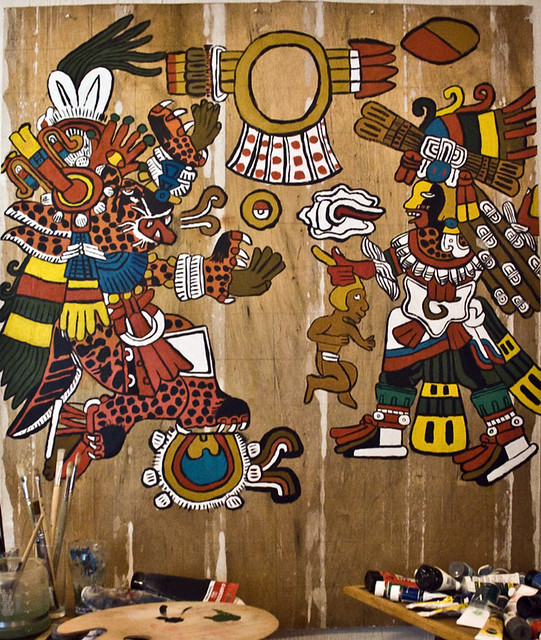
[Tezcatlipoca vs Quetzalcoatl.

Credit to Patrick Charles.]

After reading through these seven mythologies what hurts most are their implications of greater bodies of myth that have been lost through conquest, fire, and genocide, these tales of irreplaceable insight that might never be found again. But what has come down to us might yet serve as models for other value systems, other rituals, different worldly goals and heavenly rewards, showing us that the modern secular world we smugly think we know may reveal a hands-on pro-active divinity in it yet. And since that divinity is as varied as the stars are numbered, those same divinities still cast their shine & shadow through us.


#  #  #


Addenda from 9/4/2012 response to inclusion of other mythological sources:


Thanks for the praise.


Outside of Budge's pieced together interpretations, there doesn't seem to be much Egyptian source material, plus when one goes to Egypt you find out alot of the stories tend to be socio-political metaphors for Upper versus Lower Nile conflicts and resource squabbles, and more attention's focused on the dynastic legacies of the pharaohs which makes it all much less compelling, but I find their death-centric architecture & design of deities aesthetically wondrous. Just scored a Set statue this week, which is way weird because in Egypt he's really nowhere to be found, except in relief at Abu Simbel.


The Indian Mahabharata, Upanishads, and Vedic literatures just seem to be a daunting & lifetime undertaking. And where even to start such a bottomless body of study? And with whose translations? A girl recently told me a terrific story from Upanishads where a boy, via his father's offhanded dismissal, unintentionally gives his son to Yama, the lord of death. That narrative's totally my flavour of ice cream, but unsure if the overall system speaks to me on an intuitively truthful level, truth being personal and relative, (oooh, big cans of worms there. Yeah.) or it could just be it's just so outside of my cultural bias that I can't wrap myself around it spiritually. Am watching a Bollywood movie featuring re-incarnation as a central plot-point mechanism, so maybe it'll learn me something.


Right now I'm drawn again toward Norse Reconstruction, which I gather you're also curious about with your Odin post. There's some really good podcasts out there where they discuss modern paganism and the ancient lore. Ravencast's done by a well spoken East Coast professional couple who do a nice job of presentation, and Raven Radio's an unedited technical glitchfest but nearly every show there's some great perspective being issued forth from a Kindred in New Mexico with members who have completed all the serious mythology homework and aren't afraid to apply it to the now. They're all about drinking as ritual, too. Got mead?


#    #    # 


While a mostly happy bookstore fixture for over two decades, Guillermo Maytorena IV is currently willing to entertain your serious proposals for employment as a literary/cinema critic, goth journalist, castellan, airship pilot/crewperson, investigative mythologist, or assisting in a craft brewery. Should you be connected to any of the above or equally interesting endeavours, do contact him via LinkedIn or G+.

i miss my dead dog ... so what am i?

I fucking miss my dog. I miss him so much, my packmate, Buddy Guillermosson. And the thing is I know, I know he's having a good time, ...