Máni & Sunna run through the heavens,
just ahead of the wolves who will one grim day catch them.
They can expect nothing better than this.
But o' how they shine.
I run ahead,
the teeth of my dying father
and my dying marriage
that bloody my heels into sunset.
But o' how I burn,
brilliantly on my course.
Showing posts with label Norse Inspired. Show all posts
Showing posts with label Norse Inspired. Show all posts
Wednesday, May 2, 2018

Tuesday, September 26, 2017
NorsePlay: A Yank At Valhalla.
Not to let the hokey Twain-ist title fool you, Edmond Hamilton's A Yank at Valhalla delivers a Norse-inspired genre mash-up in fine pulp style.
Part lost civilization fantasy, part science fiction, Hamilton plays with the idea that behind mythology lies a greater truth.
Physicist Keith Masters, during an exploratory survey flight, gets blown into a hidden area of the arctic where he discovers the secret lands of the Norse Gods.
Stylewise, the many typos (a pulp given) are unexpectedly balanced out by some lovely .50-cent word selections, and it's neat shifting gears as a reader between scientific terms and medieval descriptors. This integrated juxtaposition aside, a lot of the presentation is stirring with cries of "Our swords for Asgard!", impressive feasting hall settings, and saga worthy melees & martial battles.
While the start isn't as fast as Lester Del Rey's The Day of the
Giants (1950), they share a conceit that a mid-century modern man can think more clearly and problem solve better than an immortal, which here is still a false conceit, and one finds Masters a few times saying things like, "Score one for my science!" to convince us, but not successfully. Anachronistic of this, Masters flies a "rocket plane", which is more than bleeding edge technology in 1940, even for a well-
funded polar expedition.
We suspect this early NorsePlay also possibly influenced Ian Cameron's Island At the Top of the World from 1961 where a polar foray stumbles onto a Viking civilization survival. And
the mix of high-tech with ancient dress reminds us of Stan Lee & Jack Kirby's Thor, which began in 1962, where the science is implied, but not overt, and one wonders if either of them read this beforehand.
In terms of what was going on in 1940, we have an American character with no horse in the race between the Aesir & the Jotuns, getting involved for various circumstantial reasons in what may very well become Ragnarok. This raises the question if Hamilton possibly wrote this as an appeal for a
U.S. entry into WW2. While the text always has the battles as being against the odds, the Viking ethos of combat being a necessary facet to support civilization and that risk being celebrated is prominent in the novella.
With pulp motifs, A Yank at Valhalla also presents the idea of the hidden subterranean. Using the dwarves (here labeled the Alfings) and a radioactive Muspelheim as a pre-surface dwelling and advanced technological world, this presages The Shaver Mystery's pulps/memoirs by half a decade:
"This was no mere cavern, but an enormous hollow such as many have believed was left under the planet's surface by the hurling forth of the Moon." (p.96)
In a current young adult novel landscape of Riordan's Magnus Chase and Armstrong's The Blackwell Pages, where overweening teen sass underqualifies as optimism, going back to an early NorsePlay like Hamilton's A Yank At Valhalla yields more imaginative treasure.
# # #
While a mostly happy bookstore fixture for over two decades, Guillermo Maytorena IV is currently willing to entertain your serious proposals for employment as a literary/cinema critic, goth journalist, castellan, airship pilot/crewperson, investigative mythologist, or assisting in a craft brewery. Should you be connected to any of the above or equally interesting endeavours, do contact him via LinkedIn or G+.
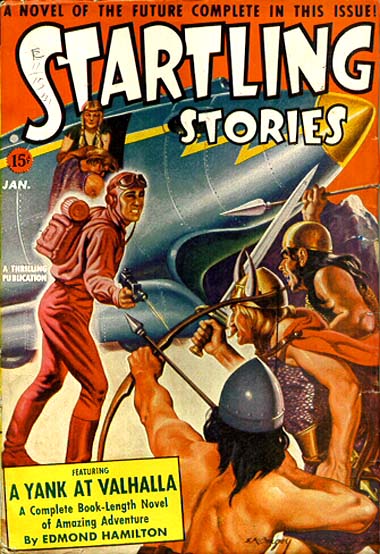 |
| [Original pulp from January 1941.] |
Part lost civilization fantasy, part science fiction, Hamilton plays with the idea that behind mythology lies a greater truth.
Physicist Keith Masters, during an exploratory survey flight, gets blown into a hidden area of the arctic where he discovers the secret lands of the Norse Gods.
 |
| [An Ace double version from 1973.] |
Stylewise, the many typos (a pulp given) are unexpectedly balanced out by some lovely .50-cent word selections, and it's neat shifting gears as a reader between scientific terms and medieval descriptors. This integrated juxtaposition aside, a lot of the presentation is stirring with cries of "Our swords for Asgard!", impressive feasting hall settings, and saga worthy melees & martial battles.
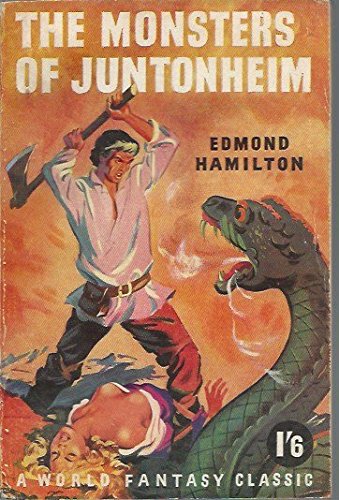 |
| [UK re-titled version from 1950. And Freya's going to fall out of that top at any moment.] |
While the start isn't as fast as Lester Del Rey's The Day of the
Giants (1950), they share a conceit that a mid-century modern man can think more clearly and problem solve better than an immortal, which here is still a false conceit, and one finds Masters a few times saying things like, "Score one for my science!" to convince us, but not successfully. Anachronistic of this, Masters flies a "rocket plane", which is more than bleeding edge technology in 1940, even for a well-
funded polar expedition.
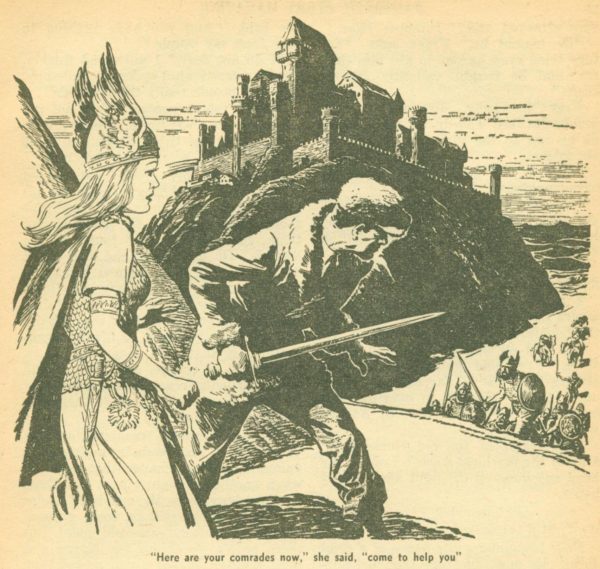 |
| [Interior art from Fantastic Story 1953 January pulp.] |
We suspect this early NorsePlay also possibly influenced Ian Cameron's Island At the Top of the World from 1961 where a polar foray stumbles onto a Viking civilization survival. And
the mix of high-tech with ancient dress reminds us of Stan Lee & Jack Kirby's Thor, which began in 1962, where the science is implied, but not overt, and one wonders if either of them read this beforehand.
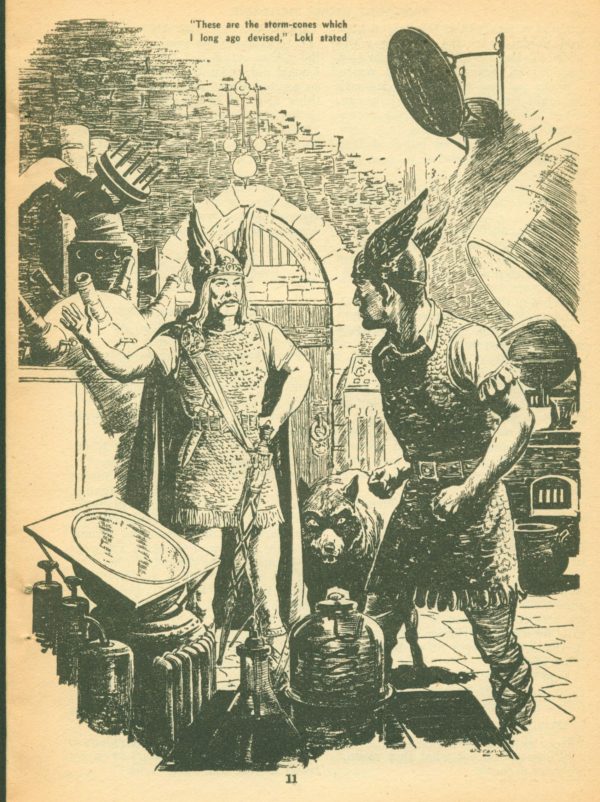 |
| [More interior art from Fantastic Story 1953 January pulp.] |
In terms of what was going on in 1940, we have an American character with no horse in the race between the Aesir & the Jotuns, getting involved for various circumstantial reasons in what may very well become Ragnarok. This raises the question if Hamilton possibly wrote this as an appeal for a
U.S. entry into WW2. While the text always has the battles as being against the odds, the Viking ethos of combat being a necessary facet to support civilization and that risk being celebrated is prominent in the novella.
 |
| [This same side-saddle valkyrie on colourless Bifrost art was also used for a later NorsePlay: Lester Del Rey's The Day of the Giants, except it was re-titled When the World Tottered.] |
With pulp motifs, A Yank at Valhalla also presents the idea of the hidden subterranean. Using the dwarves (here labeled the Alfings) and a radioactive Muspelheim as a pre-surface dwelling and advanced technological world, this presages The Shaver Mystery's pulps/memoirs by half a decade:
"This was no mere cavern, but an enormous hollow such as many have believed was left under the planet's surface by the hurling forth of the Moon." (p.96)
In a current young adult novel landscape of Riordan's Magnus Chase and Armstrong's The Blackwell Pages, where overweening teen sass underqualifies as optimism, going back to an early NorsePlay like Hamilton's A Yank At Valhalla yields more imaginative treasure.
# # #
While a mostly happy bookstore fixture for over two decades, Guillermo Maytorena IV is currently willing to entertain your serious proposals for employment as a literary/cinema critic, goth journalist, castellan, airship pilot/crewperson, investigative mythologist, or assisting in a craft brewery. Should you be connected to any of the above or equally interesting endeavours, do contact him via LinkedIn or G+.
Subscribe to:
Posts (Atom)
-
 I fucking miss my dog. I miss him so much, my packmate, Buddy Guillermosson. And the thing is I know, I know he's having a good time, ...
 -
 If I have to make a birthday speech this year at the huge party my cousin's throwing me, it will be this: In my early teens I never thou...
 -
Long out-of-print and originally published in a shorter version titled When The World Tottered in 1950, Lester Del Rey ambitiously tackles ...

i miss my dead dog ... so what am i?
I fucking miss my dog. I miss him so much, my packmate, Buddy Guillermosson. And the thing is I know, I know he's having a good time, ...
