Search

Showing posts with label Odin. Show all posts

Friday, April 29, 2016

Dumézil investigates the Gods of the Ancient Northmen.

Georges Dumézil's Gods of the Ancient Northmen surpasses the academic into the realm of poetic & enlightening, like a good professor when he's got love behind his lecture. And of these eight chapters, some actually are taken from Dumézil's lectures.


Published in 1959, this post-doctoral thesis level work of comparative mythology shows French professor Dumézil's thoughtful expansion of the study of Norse lore from the mostly associative philology it was into a functionalist sociology, which invites easier comparisons with the Hindu gods and thus backtracks their migration to the Indo-European.
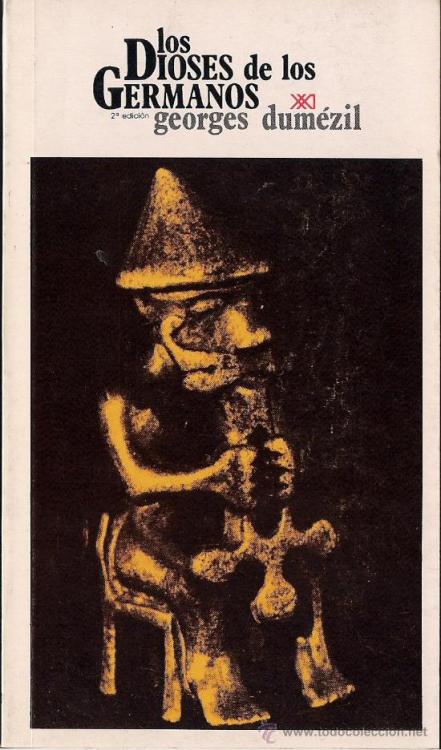


[Spanish edition cover featuring Icelandic Thor.]


Dumézil's trifunctional hypothesis posits that the functions of the gods reflect a society's factional roles, with Odin, Thor, & Frey being the major triumvirate and thus classifying that society's members into rulers, warriors, or farmers, respectively.


Also if modern Indian society is made up of castes, then Dumézil follows that this is a hold-over from Indo-European roles represented by the deities Varuṇa, Indra, & Nasatya, who also have similar functions as Odin, Thor, and Frey, and therefore correspond to those post-migration deities.


Supporting this association, Dumézil shows additional parallels between the tales of Kvasir (a being turned into the intoxicating drink of poetry) and the vedic Mada (a giant who's name means drunkenness), both importantly figuring in the end of a war between factions of the gods (Aesir versus Vanir & the Indian sky versus nature gods), and the Mahabharata's inter-familial struggle of Shakuni tricking Yudhishthira into exile compared to Loki's catspawing of Hodr to kill Baldur among the Aesir (which of course presages Ragnarök, and for the former, the Kurukshetra War).


The author also casts some grim light on the Vanir goddess Nerthus, who according to Roman historian Tacitus' Germania was in a veiled cart and given a procession to visit and bless all the towns before returning to her sacred island. Just before that return however, slaves who bathe the cart & see the goddess are drowned in her lake (!):


"From there comes a mysterious terror, the sacred ignorance of the nature of a secret that is seen only by those who are going to perish." (Tacitus, ch40)


Another reveal mentions the nail in Thor's head depicted in statues (p70), which we'd never run across until finding this illustration online:
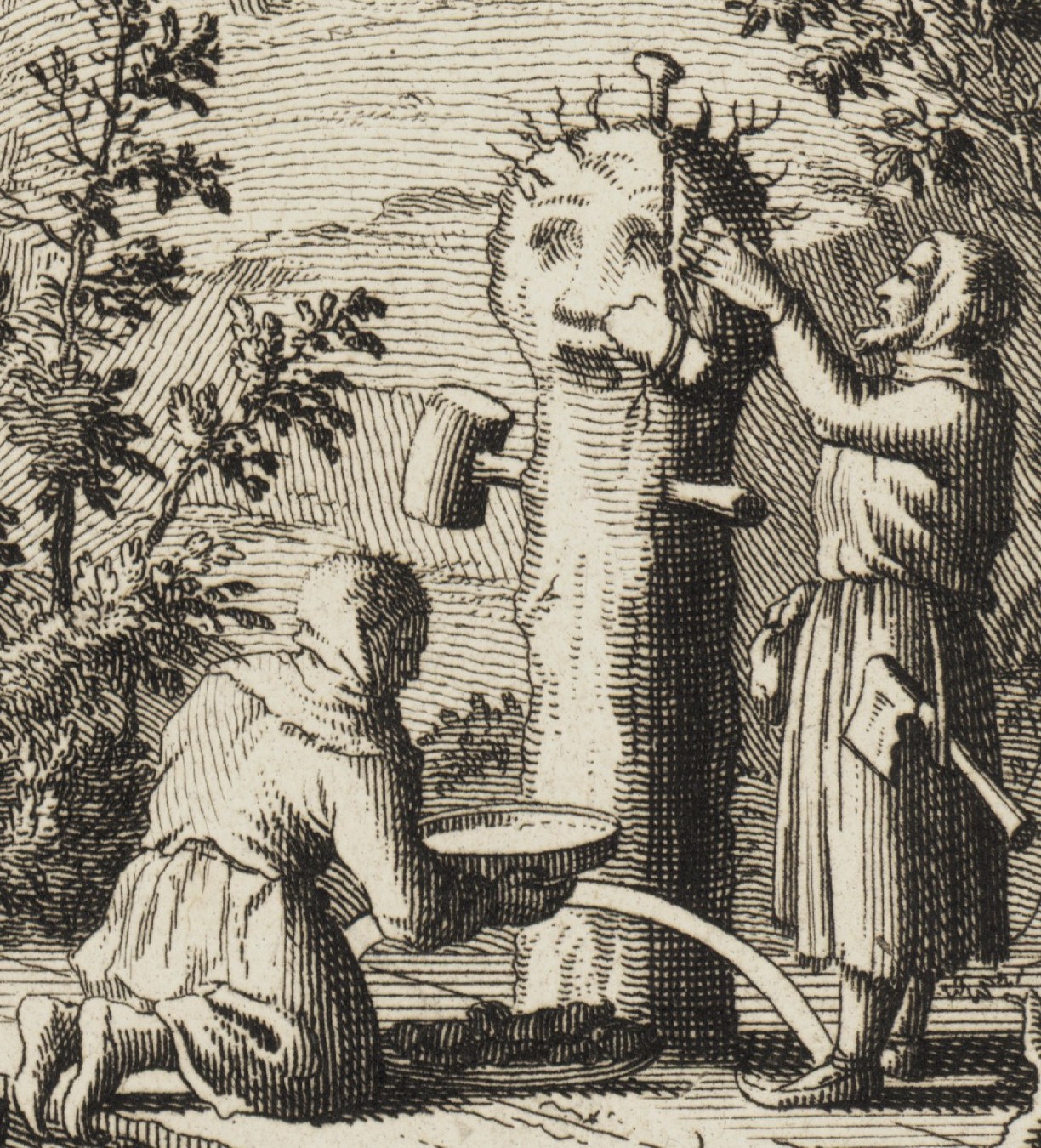


[God pole engraving of Sami storm deity Horagalles ("Thor-Man") with nail in his head hung with whetstone. By Bernard Picart, 1725.]


Dumézil likens the stuck hone from Thor's first formal duel to legendary Irish hero Cu Chulainn's hone-like shaped head "emanation" after his first battle, and would guess that there's a representation of a warrior's rite of passage in this striking similarity.


And Dumézil works out an impressive mental somersault into a what seems to be correct identities for Byggvir & Beyla, two mysterious companions to Frey passingly mentioned in the Lokasenna. From clues in retorts made by Loki, the former male is Barley, and the latter female is the Bee (this conclusion expanded in Dennis Schmidt's erudite & entertaining re-imagining of the Eddas, Twilight of the Gods), both appropriate offerings & personified associates of harvest god Frey.


Heimdall, a god with so many inexplicable epithets, also gets the acute eye of Dumézil's associative reasoning by figuring out that the "whitest of the gods" (compare to Baldur, "brightest of the gods") probably connects with another name for Freya: Mardoll (note the suffixes -dall & -doll), which means sea-light. Heimdall's sea origins come from his nine mothers, the waves, who are the nine daughters of the sea jotuns Ægir & Rán. Sailors say the ninth wave is the roughest, and therefore the most decisive of action, and that many cultures liken the foamy tops of waves to charging white animals. In the case of the Welsh and the sailors' saying, the first eight are ewes, but the strongest is the forceful ram, which gives Heimdall his godly connection with the ram, applicable to his last mother. This is but a few of the explorations Dumézil pulls together on this deity.


Parisian Georges Dumézil (1898-1986) could read Latin by age nine, served as an artilleryman in WWI, earned his doctorate in classics by comparing the Greek divine drink ambrosia with the Indian immortality drink amrita, taught in Istanbul, Uppsala, & France, achieved membership in the prestigious Académie Française, and through most of that time published many, many works on comparative mythology.


Flying in the face of the above curriculum vitae and after reading this study, we feel the tripartite theory is a simplification, an academic's need to place people in boxes using the roles of their major gods to do so. While this mirroring looks great on paper, societies have specialists (i.e. craftspeople, seers, clergy, merchants, scribes, et cetera) that do not fit in such cut & dried classifications. Yet without a time machine or further accounts one cannot discount Dumézil's trifunctional theory. We do note that in old Nordic societies the farmers were also the same warriors who went on viking raids, so while those functions were separate the same individuals did both, as per need or season. Despite this critic's disagreement with the core thesis, there's so much depth & perceptiveness that Dumézil has to teach that even the most hardcore of mythology mavens never knew of, which makes this book so worth learning from.


While there are bilingual side-by-side translations of Icelandic quotations to English, there are also many parts where German, Greek, Latin, French, and others are used but not translated, author & editor expecting their audience to know them. We should be flattered by this presumption, but instead find ourselves quite stymied, and suspect most monoglot readers will be too.


In sum Gods of the Ancient Northmen isn't so much a progression as it is a collection of papers & combined lectures, which leaves no great conclusion, but its amazing examinations can only make us scrutinize & broaden our search for answers.


[One wonders at what other insights could've been discerned if Georges Dumézil had a search engine for his library.]


The individual chapters & exploratory passages all contain great points that are provocative & illuminating. Dumézil's reasonings within Gods of the Ancient Northmen's an impressive thought exercise to get us to continue to think of our divinities in different ways in order to learn more about them -- an intellectual pursuit of insight Odin would totally approve of.


#  #  #


While a mostly happy bookstore fixture for over two decades, Guillermo Maytorena IV is currently willing to entertain your serious proposals for employment as a literary/cinema critic, goth journalist, castellan, airship pilot/crewperson, investigative mythologist, or assisting in a craft brewery. Should you be connected to any of the above or equally interesting endeavours, do contact him via LinkedIn or G+.

Tuesday, November 17, 2015

Chasing Magnus through the Norse Lore.

The unwritten criticism of young adult offerings (and it's not a genre, it's a market) is that none ever seem to pass the bar of its progenitor J.K. Rowling -- all else that follows Harry Potter's been derivative. Nor have they been able to strike such a grand balance between character & world-building as Rowling.


That bar still remains unapproached by Rick Riordan's latest trilogy series launch, Magnus Chase and the Gods of Asgard: The Sword of Summer, though you'd think with the richness of Norse Lore to draw from it might surpass the young wizard, but Magnus makes for a fun read.


Much like Riordan's Percy Jackson series, our titular protagonist has a mystery daddy, is a streetwise kid, has an important prophecy at age 16 event to propel their plot, and much internal thought reactions of sophomoric adolescent "smartness" in their texts for the teen reader & young-at-heart to identify with.


And our newly chosen hero & his varied party of gifted friends must accomplish a quest by a deadline for a lost object. Since Homer, or Tolkien, however, we never tire of this story's formula.


In contemporary fantasies our modern interpolations on ancient legends are where the humour's supposed to come from. Would today's modern man appreciate Valhalla? Maybe if it were turned into a hotel is Riordan's answer. And the pop culture references are meant to give enough perspective for a young & modern audience to see Riordan's pushing forward of the long-hidden denizens of the Nine Norse Worlds, but push the results of this technique ten years on and it might read more dated than classic. 


Where Magnus really shines is when it provides other unthought of specifics & fill-ins, such as an actual descriptor of the taste of Mimir's well of knowledge, or elaborating on the current results of Freya's bartering with the dwarven Brisings, adding to the list of "paradox ingredients", or the unique physics of Jotunheim.


"The smell of the giants' body odor -- a combination of wet clay and sour meat ..." [p.388]

These new imaginings give the reader some nice mythological extras.


Another cool hard copy reader extra (because real books will always rule!) is that depending where you buy your copy, you actually get something extra: If off a pallet at CostCo, it's a bookmark. If from the shelf of Barnes & Noble, it's a small pamphlet guide to the Norse Gods. If from the bestseller rack at Target, it's a mini-poster of the Nine Worlds. And there's even a limited edition slipcased version if you order yours from Amazon UK.


Points in the plot borrow many episodes in Norse Lore but instead place Magnus & Co within them, so if you've read the original stories you'll be the inside reader:


"We met at that party at Bilskirner -- the one where you were playing tug-of-war with Loki?" 


"Oh ... ." [He] shook his horns. "Yes. That was embarrassing." [p.343]


... but not so surprised, and if you haven't read the stories the narrative will be new ... but weirdly seeming a bit forced. There's a familiar eagle dragging a character, some fishing for a large sea monster, a deception by giantesses, et cetera. Some of the comparative situations are funny, while others fall flat from trying too hard.


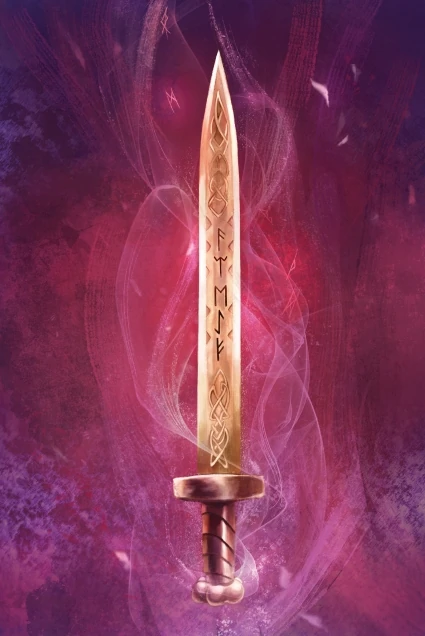
For Rick Riordan fans, Annabeth Chase from Percy Jackson cameos, turning out to be Magnus' cousin. This also implies a shared universe which might lead to a conflict between the pantheons ... ? Maybe even a duel between Percy & Magnus? (A Red Gold on Magnus! Sumarbrander totally breaks Riptide.)


[Sumarbrander!] 

While in the Lore the monsters are universal forces of entropy & destruction, in Riordan's worlds they are external manifestations of our fears & anxieties amplified, reflections of fault & weakness & regret, giving the characters' encounters with them a more crushingly personal aspect.


And in an interesting setting decision, Texan Rick Riordan celebrates his own Boston transplantation by imbuing Beantown with a close connection to Yggdrasil, the World Tree, thus making the northeastern city a crossroads to getting from Midgard, our world, to the other Nine Worlds.


In contrast to the Lore, sometimes the book puts itself at odds with the lessons in the original stories. Odin teaches that knowledge sometimes requires levels of personal & impersonal sacrifice, but Magnus questions this and frequently whines & opines differently as he proceeds on his quest.


We would adore it if Magnus Chase were to give kids & adults new to the epic accounts of the Norse Gods the same wonder & fascination that we got from D'Aulaires' Norse Gods & Giants (which really still stands as the best [even if Magnus currently outsells it on Amazon]) when we were growing up, and enough to direct them to later go read the Eddas where they came from. In all, Riordan, previously a teacher by trade, has written an entertaining embroidery of the lore that hopefully opens this door to Asgardian narratives.


Part two of the Magnus Chase trilogy, The Hammer of Thor, is scheduled for release October 4th, 2016. We can only hold out a reader's hope that this upcoming literary Mjölnir can finally smash Potter's wand.


#  #  #


While a mostly happy bookstore fixture for over two decades, Guillermo Maytorena IV is currently willing to entertain your serious proposals for employment as a literary/cinema critic, goth journalist, castellan, airship pilot/crewperson, investigative mythologist, or assisting in a craft brewery. Should you be connected to any of the above or equally interesting endeavours, do contact him.

Tuesday, October 20, 2015

NorsePlay: ideas from the Odin Brotherhood.

When Professor Mark Mirabello published The Odin Brotherhood (1992) surely many dismissed the idea of a surviving secret society of religious Norse practitioners as an attractive fantasy, or thought the dialog in the book only an Edda-like delivery system for a revival.


Understandably any sort of unearthed esoteric knowledge revealed after hundreds of years using unconfirmable sources opens itself up to scrutiny & examination, especially by reconstructionists who've had to weed out and re-plant structures in their religion, and we leave it up for those better versed in the archaeology & attestations in Asatru lore to do so.


What can't be argued is that Mirabello serves up some interesting ideas & perspectives onto the Asatruar's table, which we will present & ourselves extrapolate on here from the 5th edition (we don't have the current 6th edition [but if the publisher wished to send us one, we'd be happy to examine & revise this survey in light of the additional 50 pages, and even comment on Jack Wolf's complimentary The Way of the Odin Brotherhood {2013}, if included]).


[Bifrost to Asgard backdrop in Richard Wagner’s "Das Rheingold", directed by Otto Schenk (1990).]

The gods are presented throughout the text with unheard of epithets & cognomen, so much like the lore in using metaphorical descriptors & narrative associations to speak about the Aesir, which makes for some new additions one could use in writing or ritual.


Unlike in the Eddas, where it's the death of only a few of the gods that are detailed during the cataclysmic Ragnarök, we get a very grim additional description of the deaths of Frigg & Iðunn: "Freya will slay several trolls before she herself is killed, Idun [sic] will be soiled and raped and murdered" (p.102). There always seemed to be the implication that frost giant Þjazi perhaps did more than hold the youth-giver for her apples, but here the brutality upon her is made explicit & final.


As per the Brotherhood's origin story, a lead tablet will communicate to a dead person if buried at their grave in the winter (p.17). It's the exception that the dead answer, and it was a reply that formed their secret society.


The OB claim there are three types of death that lead to three different afterlife realms: Death in battle, the straw death of old age/sickness, and death by sorcery. Death in battle is a requirement in order to psychologically face death again when Ragnarök comes. In stark contrast, death by magick is bad since that ending denies the final army better numbers, thus giving us a longterm applied reason to avoid using magick for fatalities in the first place, which the OB states is "killing with words" and used by "all who thrive on malice" (p.74). The need for battle death also makes a fitting justification for Odin's grand plan to prepare for Ragnarök.


"Some men become terrified and dizzy at great heights. According to an old legend, it is the proximity of the gods at great heights that makes people afraid." (p.50) This passing detail jibes with citations that meditations to seek clarifying visions took place on high places, much like Odin camping on high seat Hliðskjálf to gain the best perspective.


All the gods cast a "light shadow" more like a reflection, as opposed to our conventionally dark shadow; therefore they'll only visit Midgard at night so as to conceal themselves (p.33).


Time between Asgard & Midgard passes at different rates: "An instant in the reality of the gods is an epoch in the reality of men." (p.61) This temporal difference could account for divine superspeed, seeming multi-locatant, and the need for special apples to offset aging. If men enter the reality of the gods, aging occurs, a reversed principle similar to the fairyland tales where visiting/kidnapped mortals don't age, while time passes much faster back home.


As for other realms, the OB locates Alfheim "where every river begins": "Rain is where every river begins, so the Elf-World is somewhere in the architecture of the clouds" (p.67). 


Frost giants & fire giants "exist in oblique corridors" (p.43), implying a nearby plane or dimension where they lay in wait for those barriers to break down when the universe ends. Sort of Lovecraftian, yes?


Death is hands-on sexy:


"AUTHOR: From the Odinist perspective, what is death?


THE ODIN BROTHERHOOD: In poetic terms, death itself is personified as beautiful females who exist in an endless variety of exquisite forms. These females are called the valkyries.


AUTHOR: And these valkyries extinguish life?


THE ODIN BROTHERHOOD: Yes. The gentle hands of the valkyries softly and voluptuously do the work of killing." (p.71)

Well, if you're putting it like that, death is a welcome pornography.


Endtimes update: Baldur is already dead (p.82). As the forerunning prophecy for Ragnarök, this places a greater urgency on the current state of things as far as the OB see it.


The text also presents the idea of time as an eternal cycle, similar to science's oscillating cosmology theory where the universe big bangs out (like Niflheim's ice mixing with Muspelheim's fire to explode matter into being), then gravity stalls the expansion and draws it back to collapse onto itself, only to bang out again, but the gods return with every universal genesis, like the lore mentioning Baldur's return after the sturm und drang of the current world's end is finished and everything resets. 


As for fate, it is something that's already woven out for us (p.93): "We cannot choose the joys or the terrors we must face, but we can choose to face them calmly. That is our freedom." Ergo, the inevitable's going to happen, but how we deal with it makes the difference.


And finally, the OB claims that when honor & heroic action are no longer found on Midgard, the separate worlds will break down, and Ragnarök will happen. So in the very act of honouring the old gods, we stave off Ragnarök indefinitely, and that alone is reason enough to venerate the Aesir. It's in our interest & the gods' interest to blot, for these interests of preservation, celebration, and recognition are one in the same.


Whether one buys the Eddaic adornments of what the OB's secret lore says or not, they provoke us to rethink what we know, and their last and most important point reminds us that in honoring the gods, we also honor the potential for our best selves and the world around us, all in the same horn, and that alone is worth listening (and drinking) to. 


#   #   #


While a mostly happy bookstore fixture for over two decades, Guillermo Maytorena IV is currently willing to entertain your serious proposals for employment as a literary/cinema critic, goth journalist, castellan, airship pilot/crewperson, investigative mythologist, or assisting in a craft brewery. Should you be connected to any of the above or equally interesting endeavours, do contact him via LinkedIn or G+

Friday, January 3, 2014

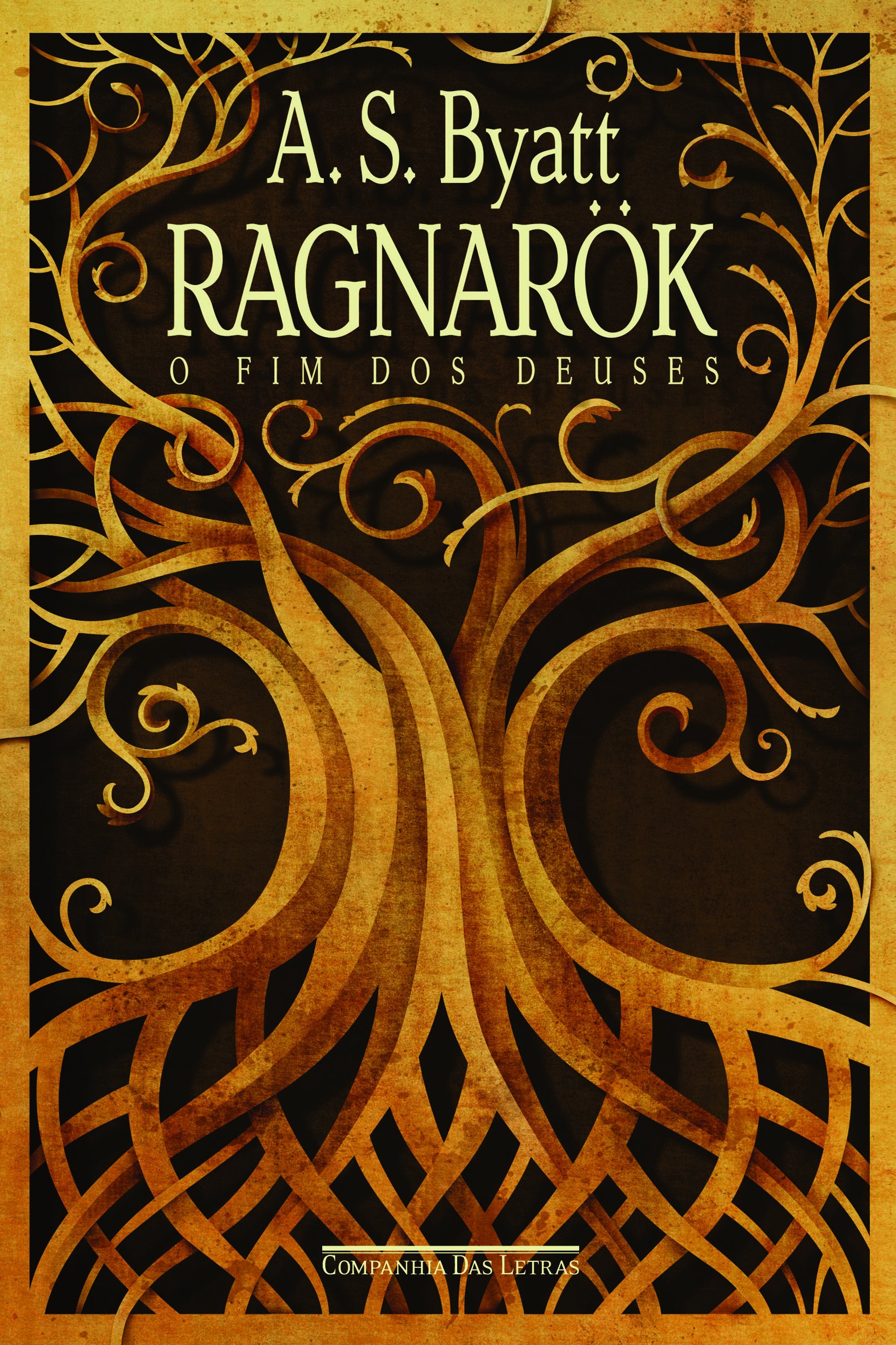
Byatt's Ragnarök: re-purposing mythology.

After reading trendy Eggers' underwhelming recent essay on the D'Aulaires' childhood classic Norse Gods & Giants (which one already knows is wondrous all-ages magic without his stamp of uninsightful approval), running across celebrated A.S. Byatt doing her take on Norse lore was an offering Nine Worlds better.


Known for one of the most refined epistolary novels, the Booker Prize winning Possession (1990), which will rip your heart out and make it pump tears of saddest sad sadness, one can only imagine the Wagnerian angst & pathos such a talent could lend to the verses of the Gods. Yet the tender Possession and the Icelandic skald Snorri Sturluson's mythopoeic collection are also worlds away from each other, and the gap shows at times.


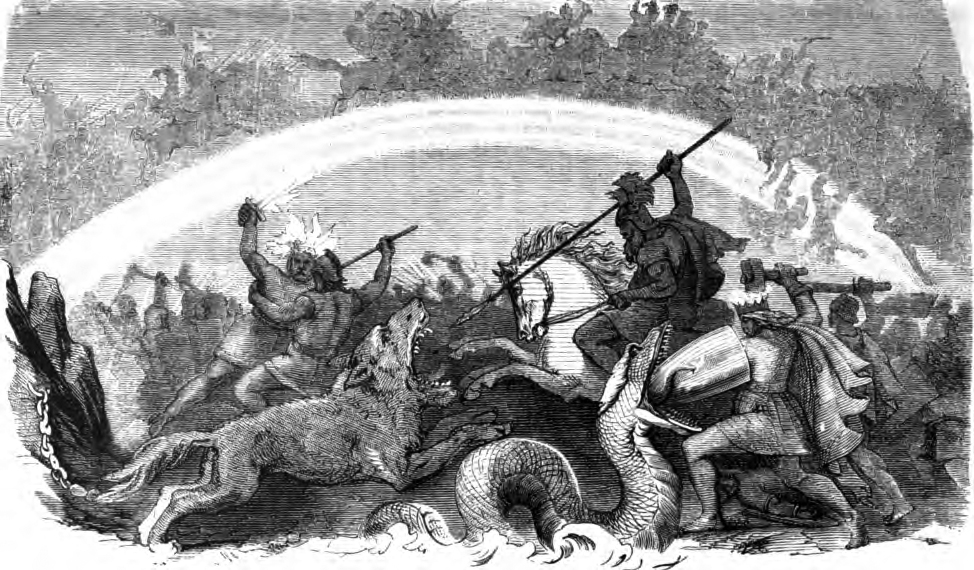
[Friedrich Wilhelm Heine's "Kampf der untergehenden Götter" (1882).]

In Ragnarok: The End of the Gods (2011), Byatt brings her own modern insights into the built-in eschatology of the Northmen. While she's hardly the first one to do this academically or creatively, having her mind turned toward a personal interpretation gives one surprising perspective on Asgard and its gods. While many dismiss Loki as an antagonist for antagonism's sake (or conversely worship him [semi- or even non-apologetically] as a divine medium of difficult change & transformation), Byatt presents Loki less as a god of mischief and more as an explorer of the patterns found in chaos theory, an outsider by nature of his extremely inquisitive, and possibly superior, mind. This also lets us to see how the higher functioning Odin continues to allow his both disruptive but useful presence as a blood brother and travel companion, as Odin may have more in common with Loki on intellectual levels than the others of his heavenly house. Byatt also puts forward the theory that Loki is part of the original triumvirate who creates man & woman from an ash & elder tree, and specifically is able to contribute to the miracle of mankind by transmuting the tree's sap into blood, making him far more integral to humanity's story. She also explains that Odin ascends to be the ruler over his two man-making peers as he sacrifices himself, his eye, and identity, for ecstatic knowledge.


Byatt also a offers a psychological take on the monstrous wolves who chase the sun & moon across the sky as "wolves of the mind", an ever-present built-in idea of the intellect's potential for self-destruction manifest as the ravening creatures that threaten to swallow the sources of illumination in ourselves & the world. Plus she posits that if the wolves weren't there as the clockwork that drives day into night and night into day, there would be no demarcations of time or season without them, and no universal/internal motivators to keep ourselves achieving instead of descending into darkness or lassitude.


Framing all this re-appropriation of the lore is Byatt herself presented as "the thin, pale child", a nameless girl displaced into the countryside by the Blitzkrieg of World War II (much like a Pevensie of Narnia), with naught much else but a copy of a Norse mythology book to give her some strange & fantastic comfort. The child's voice is hardly that of a child, but of our 75-year-old authoress looking back at herself, and at the Heathen legends that fascinated her far more than the compulsory trips to monotheistic church or a secular schoolhouse.


Outside the lines, Ragnarok succeeds as a commentary of amazement with a wonderfilled personal embellishment, an ambitious filling out of the cosmology. Most inventive is Randrasill, the undersea skeletal analogue to Yggdrasil, her construct equally full of life, giving the reader a deepwater survey of the aquatic legion that surrounds Midgard. Exiled into this world by Odin, Byatt also performs another first by presenting a POV from world serpent Jormungandr, and adding scenes of Loki's fathership in raising his daughter from simple sea snake into an ominous ouroboros.


Less than these two inventions, Byatt lends her explanations to the Baldur story. One always questions that if Baldur's death means the worlds' end, why would the gods make a game of throwing potentially deadly things at him? Yet once the gods come up with it, "Hit the Baldur" isn't just an afternoon novelty but the best-game-ever invented, and they find they can't stop from playing. One also questions why if Frigga went through the trouble of ranging the whole of the Nine Worlds to obtain a promise from everything animate & inanimate, how did mistletoe get neglected? We find that mistletoe appeared in the world just after this infinite contract was closed, that it was still childlike and "too young to make a promise", leaving its innocence open for Loki's manipulation into a weapon.


When Ragnarok does unfold, another in-battle perspective Byatt presents is that Thor doesn't realize he's been poisoned until it's too late, turning to brag to the Aesir that he bested his nemesis and lived, only to fall to the venom on his ninth & very last step.


[Marvel Thor is not amused.]

Vocabulary of note is the repeated use of the fatalistic word "ineluctable", and the admirable neologism "ur-book". ("Ur-book"! Wow!)


Conclusions? Ultimately there's no payoff with the Nazi threat, or the conflict inherent in her Germanic heritage, or a ratification of a Heathen worldview, so the framework for the storytelling's inconclusive as it never comes back around to the pale child who is Byatt in any satisfying way. There could've been a sort of Teutons versus Angles call-forward, an examination of the "wolves" that drive the conflict of war, like natio/tribal fascism, and comment on the necessity of preparation for war, but none of these ideas are ever truly exercised.


Byatt uses parts of Ragnarok as an allegory on our inability to save the world, to change our story, and in her afterword goes so far as to place her interpretation's concern for the world as an ecological one, which is a thoroughly modern use. The disconnect here's evident: Byatt's contemporary purpose is not the timeless purpose of the lore. Not to say that the Norse creation/apocalypse doesn't contain everything (oh it surely does), but the tenuousness of physical existence more reflects man's barely sustainable grasp in a world of forces that defies his daily living with an unrelenting ice & harsh frost that deny him resources and its impact on him, as opposed to his impact on it. If one can bypass this mis-inversion, there's alot of other grand exploration to be had in Byatt's otherwise earnest rendition the Norse lore. Like in Possession, there's a strong lifelong and even more cosmic love here that cannot be denied.


#   #   # 


While a
mostly happy bookstore fixture for over two decades, Guillermo Maytorena
IV is currently willing to entertain your serious proposals for
employment as a literary/cinema critic, goth journalist, castellan,
airship pilot/crewperson, investigative mythologist, or assisting in a
craft brewery. Should you be connected to any of the above or equally
interesting endeavours, do contact him.

Thursday, November 7, 2013

a second marvel-ous norse saga.

Co-opted from Norse lore by writer Stan Lee & artist Jack Kirby in 1962, their comic book Thor was designed as an adversary for The Hulk, but in selecting such a richly backgrounded character their story's potential far outgrew a mere contest-of-strength rivalry with the moody green simpleton in purple stretch pants. And here we are, hundreds of issues and half a century later, treated to the doom-filled thunder of Marvel's second pantheon-based cinematic blockbuster "Thor: The Dark World".


With the withdrawal of Shakespearian first director Kenneth Branagh due to Disney's less-generous shooting timetable, the sequel's helmed by Alan Taylor (episodes of "Game of Thrones"/"Mad Men"/"The Sopranos"), but the main difference being instead of having hammerless Thor humbled among the down home people of enchanting small town New Mexico, we find ourselves on a eye-goggling tour of the multiverse with the fate of not just frost giant populated Jotunheim to consider, but all the Nine Worlds at stake from a long-thought dead re-awakened ancient enemy.


Best performance in the film goes to ... Iceland! Iceland's starkness & desolate beauty easily depicts another world (most recently done in "Prometheus"). From a Thor-centric standpoint, it's appropo to use the nation with the most Thor prefixed place names, and who therefore historically honoured Thor the most. Volcanic rock, ashen landscape, outcroppings sculpted from tectonic violence, dancing aurora borealis, and midnight sun, all work to distance the viewer from the idea of a soundstage or digital environment with Iceland's abundantly exotic amazingness.


Best cameo goes to ... London! (Sorry, loveable Stan Lee.) It's great to see Marvel leave Manhattan as its metropolis of choice and upscale to some well-known London location placement. St. Paul's Cathedral, The London Eye, Greenwich Naval College, Thames River, Charing Cross Station, The Gherkin, and more. Having heroes & villains duke it out to damage some of those precious sites gave "T:TDW" a risk & flinch factor that hits literature's most beloved home, and that's also effectively played for laughs without breaking the tension.


The multiversal itinerary continues with glimpses of some of the other Nine Worlds: a beginning action sequence in Vanaheim, a flashback to Svartalfheim, a later stop through Jotunheim, and alot more of the home of the gods, Asgard, the Realm Eternal. And it's all these settings that lend the film a grandeur & scope worthy of Jack Kirby's world-building legacy.


[Jane Foster, you big Midgardian tourist!]


With any smart sequel the good things are carried forward: knit-bundled intern Darcy Lewis' perfectly timed quips (oh-so-hawt Kat Dennings), awkwardly cute astrophysicist Jane Foster (originally a nurse), the gratuitous Chris Hemsworth beefcake moment, parascientific explications of mythology, trickster Loki trickin', oh-no-we-shouldn't-do-it Asgardian decisionmaking, Idris Elba (BBC's "Luther") as stalwart Heimdall, Odin's sweet massive golden throne Hlidskjalf, all reappear to give us the touchstones we've waited two years to see again.


The first film was rooted in a father-son-son story, because having your dad running the universe as ruler of the gods while you bide your time over millennia for his job is bound to make heirs competitive, but after the first flush of obvious anger is spent, the complexity borrowed from the original Eddaic characters comes into play in this second chapter. The story continues to explore fallout from the Thor/Loki brotherly dynamic explosion in "The Avengers" (an overly bombastic offering which should be edited down to the Thor/Loki bits [and the shawarma eating easter egg because who ever really bought such a poorly mismatched group as The Avengers getting stuck together]), and expands upon an idea that resembles "The Animatrix" (2003) short "Beyond".


Other changes include the role of dashing Fandral being recast from Josh Dallas to Zachary Levi due to Dallas' obligations to "Once Upon a Time", energy & modern-style projectile weapons getting put up against the Asgardians' melee ones, an odd underused cameo from character actress Alice Krige (The Borg Queen from "ST: First Contact") as healing goddess Eir, and also underused Tony Curran (Marcus Corvinus of "Underworld: Evolution") as Odin's father Bor.


By contrast Rene Russo as Frigga gets a much longer turn as more than a foil for Anthony Hopkins' Odin and delivers a divine performance.


"T:TDW" presents some of the most striking design work, most notably an illuminated book whose designs animate on the pages themselves (with "The Secret of Kells" style but cooler since it's on a live action prop, or bearing resemblance to the limited but potent storytelling technique in a Marvel motion comic, such as "Thor & Loki: Blood Brothers" [which is in itself a really, really awesome Loki setpiece story]).


[Or like The Diamond Age's "A Young Lady's Illustrated Primer"!]

And there's the floating Jelling knotwork chandeliers which rotate & glow in Asgard that were totally golden, beautiful, and made you wish you could decorate with them.


Hearkening back to some 1960s film intros & outros, there were gorgeously painted end credits, meant to remind us that all of this visual richness originally came from a tradition of 1960s illustration.


Best of all "T:TDW" continues to fill in Marvel's mythological blanks in the Asgardian storyline, while still leaving some open for a definite trilogy in the making. Hail to the Hammer for "Thor 3"!


#  #  #


While a mostly happy bookstore fixture for over two decades, Guillermo Maytorena IV is currently willing to entertain your serious proposals for employment as a literary/cinema critic, goth journalist, castellan, airship pilot/crewperson, investigative mythologist, or assisting in a craft brewery. Should you be connected to any of the above or equally interesting endeavours, do contact him via LinkedIn or G+

i miss my dead dog ... so what am i?

I fucking miss my dog. I miss him so much, my packmate, Buddy Guillermosson. And the thing is I know, I know he's having a good time, ...