Search

Showing posts with label lit crit. Show all posts

Tuesday, September 26, 2017

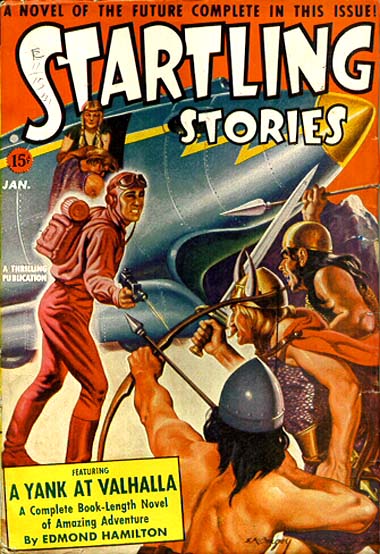
NorsePlay: A Yank At Valhalla.

Not to let the hokey Twain-ist title fool you, Edmond Hamilton's A Yank at Valhalla delivers a Norse-inspired genre mash-up in fine pulp style.


[Original pulp from January 1941.]

Part lost civilization fantasy, part science fiction, Hamilton plays with the idea that behind mythology lies a greater truth.

Physicist Keith Masters, during an exploratory survey flight, gets blown into a hidden area of the arctic where he discovers the secret lands of the Norse Gods.


[An Ace double version from 1973.]

Stylewise, the many typos (a pulp given) are unexpectedly balanced out by some lovely .50-cent word selections, and it's neat shifting gears as a reader between scientific terms and medieval descriptors. This integrated juxtaposition aside, a lot of the presentation is stirring with cries of "Our swords for Asgard!", impressive feasting hall settings, and saga worthy melees & martial battles.


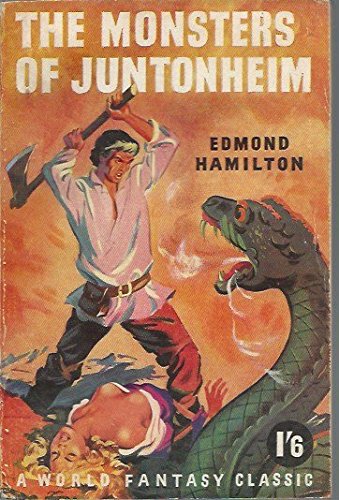
[UK re-titled version from 1950. And Freya's going to fall out of that top at any moment.]

While the start isn't as fast as Lester Del Rey's The Day of the

Giants (1950), they share a conceit that a mid-century modern man can think more clearly and problem solve better than an immortal, which here is still a false conceit, and one finds Masters a few times saying things like, "Score one for my science!" to convince us, but not successfully. Anachronistic of this, Masters flies a "rocket plane", which is more than bleeding edge technology in 1940, even for a well-

funded polar expedition.


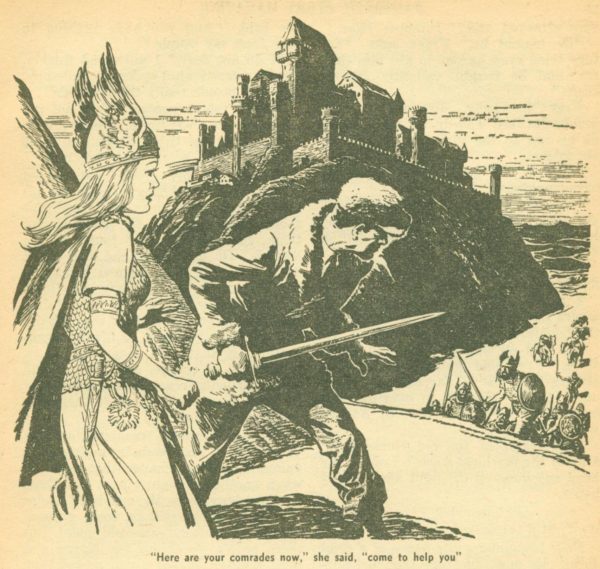
[Interior art from Fantastic Story 1953 January pulp.]

We suspect this early NorsePlay also possibly influenced Ian Cameron's Island At the Top of the World from 1961 where a polar foray stumbles onto a Viking civilization survival. And

the mix of high-tech with ancient dress reminds us of Stan Lee & Jack Kirby's Thor, which began in 1962, where the science is implied, but not overt, and one wonders if either of them read this beforehand.


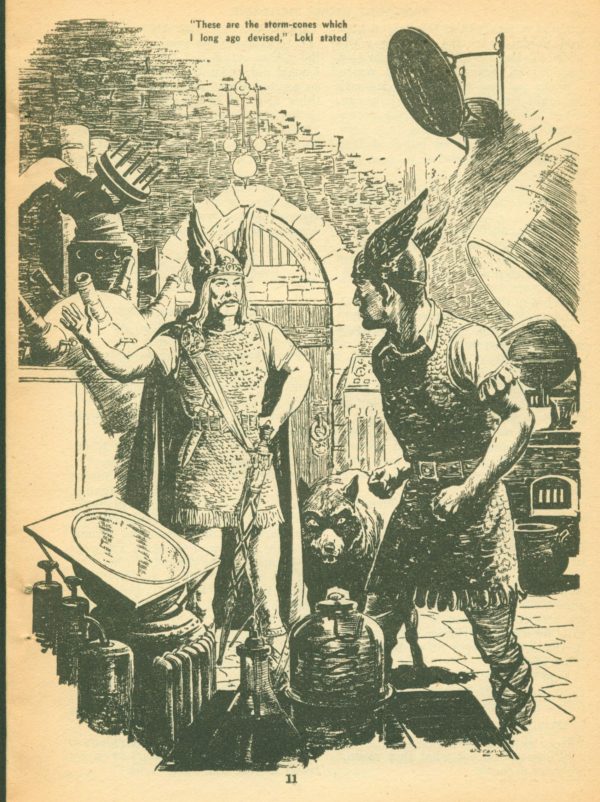
[More interior art from Fantastic Story 1953 January pulp.]

In terms of what was going on in 1940, we have an American character with no horse in the race between the Aesir & the Jotuns, getting involved for various circumstantial reasons in what may very well become Ragnarok. This raises the question if Hamilton possibly wrote this as an appeal for a

U.S. entry into WW2. While the text always has the battles as being against the odds, the Viking ethos of combat being a necessary facet to support civilization and that risk being celebrated is prominent in the novella.


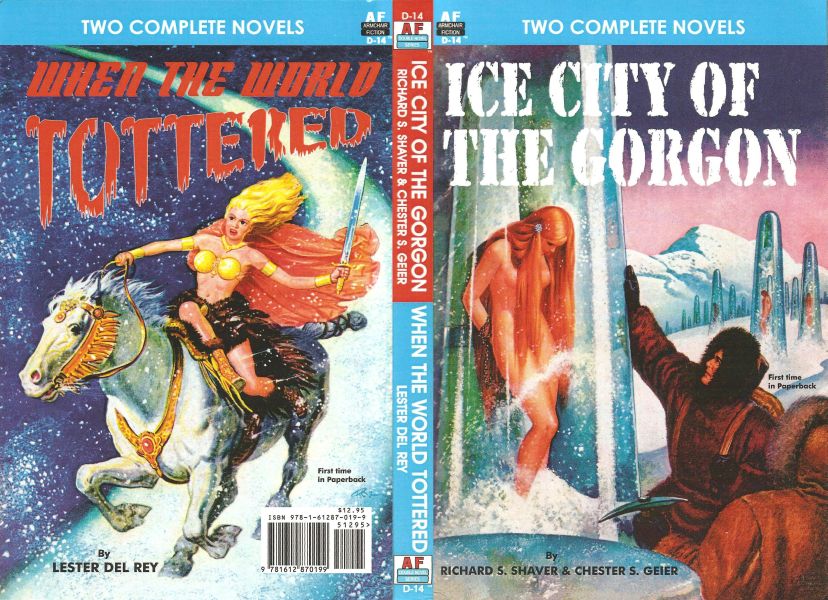
[This same side-saddle valkyrie on colourless Bifrost art was also used for a later NorsePlay: Lester Del Rey's The Day of the Giants, except it was re-titled When the World Tottered.]

With pulp motifs, A Yank at Valhalla also presents the idea of the hidden subterranean. Using the dwarves (here labeled the Alfings) and a radioactive Muspelheim as a pre-surface dwelling and advanced technological world, this presages The Shaver Mystery's pulps/memoirs by half a decade:

"This was no mere cavern, but an enormous hollow such as many have believed was left under the planet's surface by the hurling forth of the Moon." (p.96)


In a current young adult novel landscape of Riordan's Magnus Chase and Armstrong's The Blackwell Pages, where overweening teen sass underqualifies as optimism, going back to an early NorsePlay like Hamilton's A Yank At Valhalla yields more imaginative treasure.


#    #    #


While a mostly happy bookstore fixture for over two decades, Guillermo Maytorena IV is currently willing to entertain your serious proposals for employment as a literary/cinema critic, goth journalist, castellan, airship pilot/crewperson, investigative mythologist, or assisting in a craft brewery. Should you be connected to any of the above or equally interesting endeavours, do contact him via LinkedIn or G+

Saturday, August 19, 2017

in The Red Room of Requirement with The Pottermouthed Girls.

In a very special episode of Ruminations From the Red Room, host, dear friend, and person of exception Mitch +George Proctor allowed Dark Entries the privilege of inviting +Gwyen Raamat & +Melissa Kailani Negelspach, the duo known far & wide as The Pottermouthed Girls to podcast about most people's favourite wizardboi & his world.


Listen to us here.


Mitch's blurb:


We speak with Gwen and The Unicorn, champions of the Geeks Who Drink,
masters of the Potter knowledge, and keepers of the words. The ladies
join Guillermo to sit, and wax poetic, philosophical, and literal on
J.K. and her work. Comparisons are unavoidable to greats like Professor
Tolkien, and we work together to sort out our feelings, and fandom. It’s
really just a get to know you, to prep for next time when the gloves
really come off.


Gwyen the Valkyrie & Melissa the Unicorn are the people I know who are most passionate about the wizarding world. They read the books annually, keep up with the Pottermore site, and can probably cast all the spells in their sleep faster than you can think Avada Kedavra. Ergo, we knew it was going to be the goodness when we sat behind Mitch's three magic (and one less than magic since Mitch gave me the one from the muggle's back alley dollar store) mics to use our literary divination skills.


[I will beat you for Slytherin!]

We fan-out, and much more importantly, we examine why HP's a global cultural phenomenon and not just another kids' book series that people trade in for gas money once they graduate from high school.


Also we discuss the vacuum of a post-Saxon mythology for England that Tolkien attempted to fill, how Rowling successfully built upon that, and how these NorsePlays rest on the most fantastic foundation of all that is Norse Mythology & Lore.


So put on your house colours (green & silver rule, fool!) and strap on your extendable ears for a pleasant time on the Red Room Express Train.


[Ride or die!]


#   #   #


While a mostly happy bookstore fixture for over two decades, Guillermo Maytorena IV is currently willing to entertain your serious proposals for employment as a literary/cinema critic, goth journalist, castellan, airship pilot/crewperson, investigative mythologist, or assisting in a craft brewery. Should you be connected to any of the above or equally interesting endeavours, do contact him via LinkedIn or G+.


Friday, March 17, 2017

NorsePlay: Neil Gaiman's "Norse Mythology".

Neil Gaiman faced the daunting task to adapt the narrative holy of the holies, the ur-book stories, the most ancient tales known to man from which all other tales have since flowed from: Norse Mythology.


As we told a childhood friend of Neil's last month, Neil is a fearless writer, that before Neil there wasn't a great movement in the fantasy genre to use the Gods as actual intimate first & close third-person protagonists.


[Neil Gaiman being fearless!]

We look back at his record for this daring talent with reading pleasure: The Sandman (his breakout World Fantasy Award-winning graphic novel series expanding the being of Greek deity Morpheus), American Gods (heavily featuring Gods from various pantheons), and Odd & the Frost Giants (a NorsePlay story for children of all ages). And now, in a tribute to pay back what originally inspired him, Gaiman offers us his version of Norse Mythology.


In his introduction, Neil points out and mourns the loss of many stories in the Norse Lore, with only hints of more left behind in epithets and kennings:


I wish I could retell the tales of Eir, because she was the doctor of the gods, of Lofn, the comforter, who was a Norse goddess of marriages, or of Sjofn, a goddess of love. Not to mention Vor, goddess of wisdom. I can imagine stories, but I cannot tell their tales. (p.14)


You big tease, Mr. Gaiman, as we're pretty sure you could draft some. (And go check out "The Almighty Johnsons" for an interesting take on these goddesses.)


One can't help but hear Gaiman's comfortable English accent while reading. (If you're unfamiliar, listen to this.) Some authors make a total hash of reading their own work (talking to you, departed Douglas Adams), but the words here just rise off the page as though you're listening by a campfire. 


The bar for comparison will always be D'Aulaires' Norse Gods & Giants, but Gaiman instead grew up with Roger Lancelyn Green's Myths of the Norsemen. This early inspiration aside, he sources Snorri Sturluson, the Poetic Edda, and Rudolf Simek's Dictionary of Norse Mythology for his current retelling.


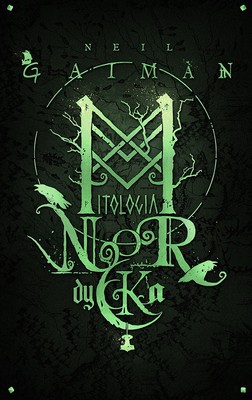
[Fenrir-fraught German edition cover.]

There's an open-endedness to the Norse Lore which allows the teller to detail in the blanks as they see fit. Everyone takes the opportunity to do so, and in this Gaiman is no different. Just when you thought you'd heard all the names for the Gods, he comes up with some original epithets, which is a skaldic achievement.


Charming anachronisms, born of Gaiman's penchant for contemporary urban fantasy (i.e. Neverwhere), make their way into his version of the Eddaic material. For instance, the giant that survives Ymir's flood of lifeblood does so by "clamoring onto a wooden box" (p.32), and smithy dwarf Brokk threatens Loki with converting his head into "A thinking machine (...) Or an inkwell." (p.55) The fact that these modern day items can flow backward and find a place inside these stories only reinforces the Norse Lore's timeless essence.


Other interesting additions and modifications in Gaiman's version include: the cosmic giant Ymir being made neither sex yet hermaphrodite, the detail of runes inscribed on the sides of Utgardaloki's bottomless challenge horn, the rationalization of Odin, Vili, & Ve wanting to create better worlds to live in & thus sanctioning the necessary sacrifice of Ymir to provide realm-building materials to do so, the prick of "Baldur's bell-like laughter...", a new character of Thyrm's conniving sister at Thor's marriage, and Mjölnir winning the the dwarven crafting contest because of its ability to protect, as Gaiman emphasizes that value far above the other entries.


Gaiman also specifically assigns the Vanir's Frey & Freya with the creation of Kvasir, which dovetails nicely into their role as both generative/creative gods and as the members of the post-war tribal exchange.


As the book continues, one can't help but notice Gaiman's enjoyment of writing Loki as a foil for events, especially seen in his extended embellishment of Loki's seduction of the giant's draft horse into something rather sensual.


"The Mead of Poets" is a brilliant standout. The dwarves who kill Kvasir are recast from spiteful miscreants into alchemists, which makes more sense for the murder's resultant beverage. And Bolverkr's underhanded wooing of Gunnlod's done as well as any modern lothario running game on a girl on any given club night.


"Hymir and Thor's Fishing Expedition" partly gets retold as a bad stepfather story, as Tyr's giantess mother marries the abusive & inhospitable Hymir, and we get a taste of Tyr's oppressive early home life.


Hel's half-dead side is descibed as looking into the "pale eye of a corpse" (the exact phrase Gaiman re-uses later for midwinter's brief and distant sun). Gaiman's previous empathetic personification of Death in Sandman may have been partly influenced by her Gothic-forbearer Hel:


"I am only myself, Hel, daughter of Angerboda and of Loki," she said. "And I like the dead best of all. They are simple things, and they talk to me with respect. The living look at me with revulsion."

One can't help but admire Hel's forthright manner, and despite the horror of her condition, she wins us with her self-acceptance, and also wins Odin when he gives her a fitting place in his cosmic scheme of things.


Gaiman reorders events to make more narrative sense. Odin raises the long dead wise woman völva only once, far later in the stories after Balder experiences his plague of nightmares. Gaiman also takes the liberty of making the völva Loki's lover & monster mother jötunness Angrboda, which makes her belligerent & doom-filled revelations to Odin more motivated. This shuffling of prophecy toward the end of things gives the reader a feeling that Ragnarök's too late to stop by the time Odin hears of it, which eliminates the usual planning versus destiny questions of why can't it be avoided if the Gods know about it from so early on in the stories' throughline.


[Hungarian edition.]

Like in Sandman, and in his introduction, Gaiman falls prey to the common slanderous reduction of Thor to a box of hammers ... which ignores Thor's verbally deft outwitting of dwaven Alvíss (actually meaning "All-Wise") to save his daughter Thrud from his amorous attentions, and Gaiman omits this story in his collection. 


A huge deviation in "The Story of Gerd and Frey" is that Gerd's refusal of Frey's proposal is completely skipped. One wonders if the coercion aspect was found to be distasteful by the author, but that's negated anyhow for most modern audiences by her finding mutual happiness with Frey at the end. He is a God of love after all, and being selected by love itself for marriage would be the ultimate compliment.


A serious missed-opportunity occurs in "The Last Days of Loki" when the "Lokasenna" usually takes place. During this episode Loki calls out all the Gods on their transgressions and shortcomings in an attempt to show them they're as mischievous as he is and hypocritical to boot (which is false since Loki's brand of mischief also harms everyone and is born of a darker motivation). Unlike Gaiman's previous writerly use of Loki, he skips the potential of this famous verbal tennis match entirely, which we found disappointing.


[Domestic cover with nordic landscaping.]

During "Ragnarok: The Final Destiny of the Gods", there's a dying exchange between Heimdall & Loki, and a gorgeous post-Ragnarok ending that movingly capstones the book.


Bottom-line: Does Gaiman significantly improve the telling? No, but his telling is respectful, adorned with thoughtful things only he would do, crafted with the fuzzy edges of myth gathered & woven into smoother narratives, poetic yet accessible, and, in many passages, beautiful & wondrous. In that meritorious achievement, Gaiman fulfills the role of that Green version he grew up with, and this new version will be the lens through which the current generation first encounters the All-Father, the Trickster, and the Thunderer. Snorri would be proud.


#      #      #


While a mostly happy bookstore fixture for over two decades, Guillermo Maytorena IV is currently willing to entertain your serious proposals for employment as a literary/cinema critic, goth journalist, castellan, airship pilot/crewperson, investigative mythologist, or assisting in a craft brewery. Should you be connected to any of the above or equally interesting endeavours, do contact him viaLinkedIn or G+.
Tuesday, January 3, 2017

NorsePlay: Lester Del Rey's "Day Of The Giants".

Long out-of-print and originally published in a shorter version titled When The World Tottered in 1950, Lester Del Rey ambitiously tackles the Twilight of the Gods in his 128-page novella.


Most authors take the easy way out by instead writing a story about nearly avoiding doomsday, but Del Rey rises to the challenge and gives the audience the lead-up and final battle ... but perhaps not just as prophesied. A predecessor to Greg van Eekhout's Norse Code, Del Rey delivered Ragnarök fifty years earlier in the genre.


An inexplicably long winter strikes, vexing weathermen, and causing worldwide privation, the results of which start communal breakdown & vigilantism in Leif Svensen's small rural town. Only because of their ancestors' stories do Leif & his recently returned prodigal brother Lee even think to reference Fimbulwinter, and when a mysterious hitchhiker also happens to mention the prophesied world-ending final winter, do the pieces begin to fall into place. 


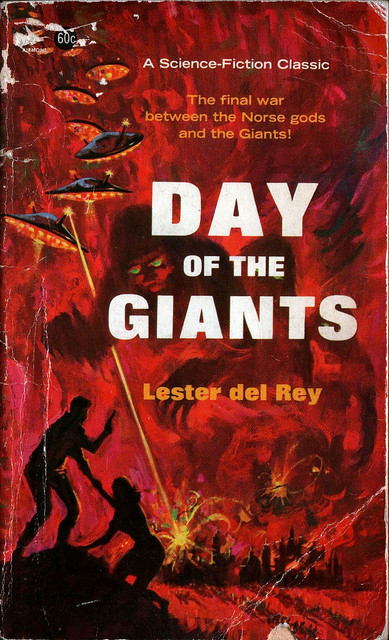
[Airmont Books takes a very misleading artistic licence with the cover art.]


Mismarketed as sci-fi given the completely errant War of the Worlds-style flying saucer attack cover, Day of the Giants is more contemporary fantasy fare, which takes a protagonist of the current day & inserts them into the warp & weft of a magical & ancient hidden under-verse. Leif & Lee are the wildcards that get shuffled into the deck that changes the game of Ragnarök.


The text has a fair share of awkward sentences and typos. But Del Rey was amazingly prolific & possibly didn't have or make time for copy editing in the rush-to-print days of quick 'n' dirty sci-fi pulp, so compared to his contemporaries, it's good on a storytelling level.


[Earlier Armchair Fiction two-fer edition, Valkyrie on Bifrost art by Robert Gibson Jones. Note the odd choice of pairing with Richard Shaver (go look up The Shaver Mystery ... which could have something to do with the Svartalfar, trolls, or huldrafolk, if one applies the lens of Norse Lore to Shaver's cthonic encounters).]

While Del Rey gives protagonist Leif a lot of then-modern American common sense & know-how, we find fault with the idea that any 20th century man would be technologically more savvy than the Gods, especially given they're cited to be 50,000 years old in the story. That they would not advance, even with a very restrictive cultural adherence, stretches credulity.


On the other hand, there are some really creative additions to the mythology that add to & fill in some blanks:


• That the Valkyries used an Alfheim magic to breathe an "elf seed", or regenerative flesh, into their chosen fallen, which is then drawn out to regenerate the hero whole back in Asgard. The new "elf flesh" then allows them to fight, die, and be reassembled at battle practice day's end.


• Freya's falcon cloak is in origin elf-made (perhaps given her brother's rulership of Alfheim?).


• Thor's hammer Mjölnir has magnetic properties which allows it to disarm others if it passes by an enemy's metal weapon. (*Yoink*!)


• Decades before the Marvel Film's "Thor" & "Thor: The Dark World" adaptations, Bifrost is not only a dimensional connector to earth/Midgard, but to all the Nine Worlds.


These extrapolations show Del Rey did a fair amount of thinking and his Edda homework. While there are some mistakes, reassignments of lore roles, and willful omissions to skip lengthy background explanations for the novella format, Del Rey garnishes his text with some lesser-used epithetical Gods' names, place references, and details that would make Snorri Sturluson proud.


[Avalon 1959 hardback cover art by Emsh. Note the misspelling of Del Rey's surname.]


In Del Rey's 1950s Atom Age, technology & the modernist future were ideals to be pursued, the new secular science replacing the old religious beliefs, and here he uses the Gods as a foil for that moral: Some traditions need to be re-examined if they stop a more useful progress. Yes, that's totally unfair to retroactively impose that ideal on the Norse Gods, especially since they inspired cultures that invented seafaring & navigational innovations to travel the world over, themselves bore the first smart weapons (i.e Gungnir, Mjölnir, & Sumarbranderinto battle, and created fish nets. But again Del Rey presents the Gods as nearly frozen in their personas & ways, so only in the context of his book can he get away with it.


Despite this then-contemporary misapplication, Del Rey's Day of the Giants is a fun read, his imaginative addenda to the lore is inspired, and seeing the details of the story NorsePlay'd out in the fateful tale of Ragnarök is rather worth it.


#     #     #


While a mostly happy bookstore fixture for over two decades, Guillermo Maytorena IV is currently willing to entertain your serious proposals for employment as a literary/cinema critic, goth journalist, castellan, airship pilot/crewperson, investigative mythologist, or assisting in a craft brewery. Should you be connected to any of the above or equally interesting endeavours, do contact him via LinkedIn or G+.

Friday, April 29, 2016

Dumézil investigates the Gods of the Ancient Northmen.

Georges Dumézil's Gods of the Ancient Northmen surpasses the academic into the realm of poetic & enlightening, like a good professor when he's got love behind his lecture. And of these eight chapters, some actually are taken from Dumézil's lectures.


Published in 1959, this post-doctoral thesis level work of comparative mythology shows French professor Dumézil's thoughtful expansion of the study of Norse lore from the mostly associative philology it was into a functionalist sociology, which invites easier comparisons with the Hindu gods and thus backtracks their migration to the Indo-European.


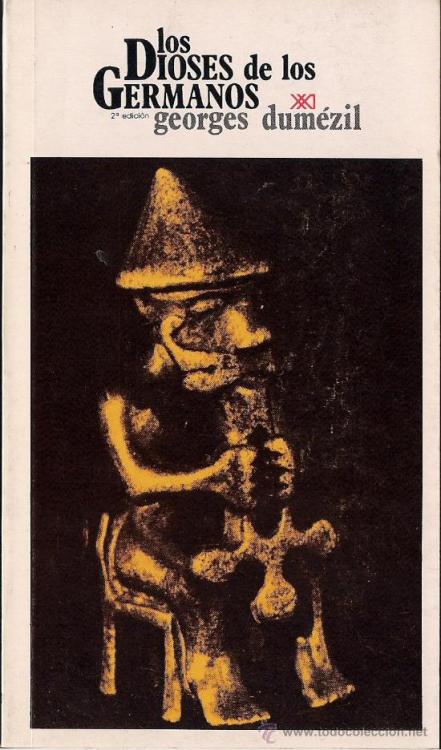
[Spanish edition cover featuring Icelandic Thor.]


Dumézil's trifunctional hypothesis posits that the functions of the gods reflect a society's factional roles, with Odin, Thor, & Frey being the major triumvirate and thus classifying that society's members into rulers, warriors, or farmers, respectively.


Also if modern Indian society is made up of castes, then Dumézil follows that this is a hold-over from Indo-European roles represented by the deities Varuṇa, Indra, & Nasatya, who also have similar functions as Odin, Thor, and Frey, and therefore correspond to those post-migration deities.


Supporting this association, Dumézil shows additional parallels between the tales of Kvasir (a being turned into the intoxicating drink of poetry) and the vedic Mada (a giant who's name means drunkenness), both importantly figuring in the end of a war between factions of the gods (Aesir versus Vanir & the Indian sky versus nature gods), and the Mahabharata's inter-familial struggle of Shakuni tricking Yudhishthira into exile compared to Loki's catspawing of Hodr to kill Baldur among the Aesir (which of course presages Ragnarök, and for the former, the Kurukshetra War).


The author also casts some grim light on the Vanir goddess Nerthus, who according to Roman historian Tacitus' Germania was in a veiled cart and given a procession to visit and bless all the towns before returning to her sacred island. Just before that return however, slaves who bathe the cart & see the goddess are drowned in her lake (!):


"From there comes a mysterious terror, the sacred ignorance of the nature of a secret that is seen only by those who are going to perish." (Tacitus, ch40)


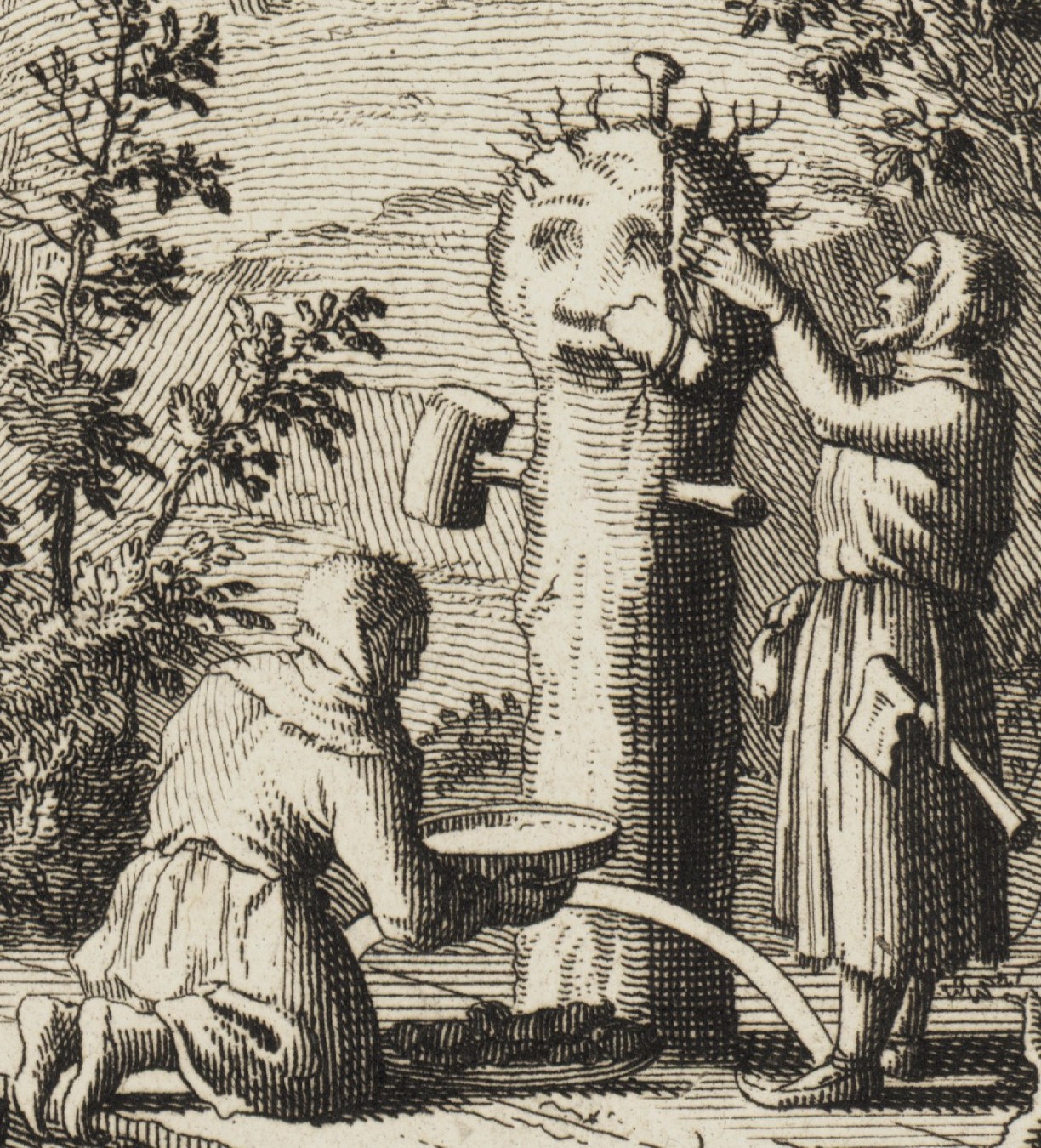
Another reveal mentions the nail in Thor's head depicted in statues (p70), which we'd never run across until finding this illustration online:


[God pole engraving of Sami storm deity Horagalles ("Thor-Man") with nail in his head hung with whetstone. By Bernard Picart, 1725.]


Dumézil likens the stuck hone from Thor's first formal duel to legendary Irish hero Cu Chulainn's hone-like shaped head "emanation" after his first battle, and would guess that there's a representation of a warrior's rite of passage in this striking similarity.


And Dumézil works out an impressive mental somersault into a what seems to be correct identities for Byggvir & Beyla, two mysterious companions to Frey passingly mentioned in the Lokasenna. From clues in retorts made by Loki, the former male is Barley, and the latter female is the Bee (this conclusion expanded in Dennis Schmidt's erudite & entertaining re-imagining of the Eddas, Twilight of the Gods), both appropriate offerings & personified associates of harvest god Frey.


Heimdall, a god with so many inexplicable epithets, also gets the acute eye of Dumézil's associative reasoning by figuring out that the "whitest of the gods" (compare to Baldur, "brightest of the gods") probably connects with another name for Freya: Mardoll (note the suffixes -dall & -doll), which means sea-light. Heimdall's sea origins come from his nine mothers, the waves, who are the nine daughters of the sea jotuns Ægir & Rán. Sailors say the ninth wave is the roughest, and therefore the most decisive of action, and that many cultures liken the foamy tops of waves to charging white animals. In the case of the Welsh and the sailors' saying, the first eight are ewes, but the strongest is the forceful ram, which gives Heimdall his godly connection with the ram, applicable to his last mother. This is but a few of the explorations Dumézil pulls together on this deity.


Parisian Georges Dumézil (1898-1986) could read Latin by age nine, served as an artilleryman in WWI, earned his doctorate in classics by comparing the Greek divine drink ambrosia with the Indian immortality drink amrita, taught in Istanbul, Uppsala, & France, achieved membership in the prestigious Académie Française, and through most of that time published many, many works on comparative mythology.


Flying in the face of the above curriculum vitae and after reading this study, we feel the tripartite theory is a simplification, an academic's need to place people in boxes using the roles of their major gods to do so. While this mirroring looks great on paper, societies have specialists (i.e. craftspeople, seers, clergy, merchants, scribes, et cetera) that do not fit in such cut & dried classifications. Yet without a time machine or further accounts one cannot discount Dumézil's trifunctional theory. We do note that in old Nordic societies the farmers were also the same warriors who went on viking raids, so while those functions were separate the same individuals did both, as per need or season. Despite this critic's disagreement with the core thesis, there's so much depth & perceptiveness that Dumézil has to teach that even the most hardcore of mythology mavens never knew of, which makes this book so worth learning from.


While there are bilingual side-by-side translations of Icelandic quotations to English, there are also many parts where German, Greek, Latin, French, and others are used but not translated, author & editor expecting their audience to know them. We should be flattered by this presumption, but instead find ourselves quite stymied, and suspect most monoglot readers will be too.


In sum Gods of the Ancient Northmen isn't so much a progression as it is a collection of papers & combined lectures, which leaves no great conclusion, but its amazing examinations can only make us scrutinize & broaden our search for answers.


[One wonders at what other insights could've been discerned if Georges Dumézil had a search engine for his library.]


The individual chapters & exploratory passages all contain great points that are provocative & illuminating. Dumézil's reasonings within Gods of the Ancient Northmen's an impressive thought exercise to get us to continue to think of our divinities in different ways in order to learn more about them -- an intellectual pursuit of insight Odin would totally approve of.


#  #  #


While a mostly happy bookstore fixture for over two decades, Guillermo Maytorena IV is currently willing to entertain your serious proposals for employment as a literary/cinema critic, goth journalist, castellan, airship pilot/crewperson, investigative mythologist, or assisting in a craft brewery. Should you be connected to any of the above or equally interesting endeavours, do contact him via LinkedIn or G+.

Tuesday, March 15, 2016

The Norse Gods Remixed.

The hard truth is that at the end of the post-conversion night, what we mostly have left of the Norse Gods are the Eddas.


And the fact is you want more NorsePlay.


We know from the Eddas' passing references there were tons more stories. And from within an oral tradition, all these tales were surely told & retold in many differing versions with emphasis placed or displaced depending on the audiences' points of interest or the skald's creative leanings. So when Norse Lore believers/followers/fans get bent that so-and-so told it "wrong" or added/subtracted things, there's an ancient & liberal precedent being celebrated with these differences.


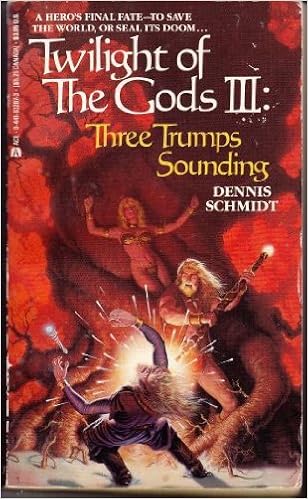
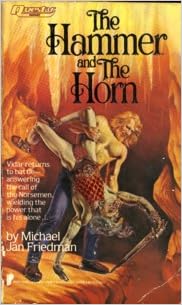
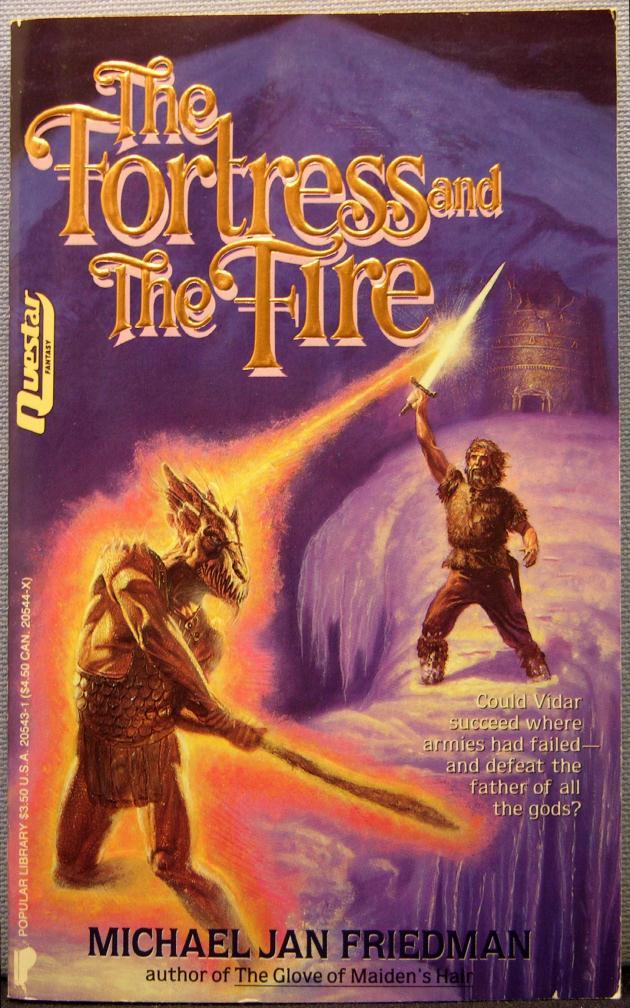
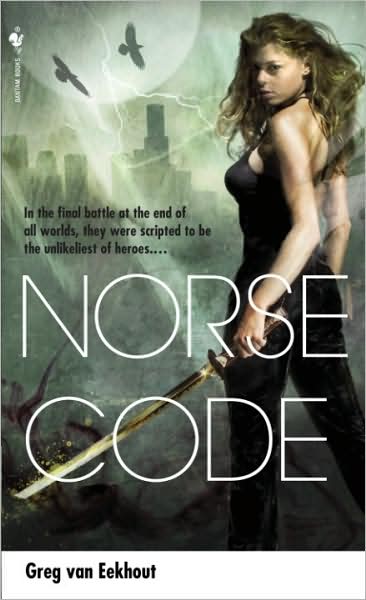
In this vein of expansive storytelling license, there's obviously Marvel's 1962 to now superhero take, but during that period Norse lore has been remixed by other daring authors, which we will survey here: Dennis Schmidt's Twilight of the Gods (1985-1987) trilogy as prequel/re-interpretive, and Michael Jan Friedman's Vidar Trilogy (1985-1988) as sequel (all pre-Neil Gaiman's American Gods [2001] & Odd and the Frost Giants [2008]), and well in advance of some conventions of Marvel and internet Rule 63 by decades. A post-Gaiman/Marvel selection also worthy of mention is Greg Van Eekout's stand-alone novel, Norse Code (2009). The first we'll review in detail, while the last two we'll briefly encapsulate.


Twilight of the Gods:


[Borr versus Surt!]


[Voden at Mimir's Well!]


[Unlike the other two, this cover art has nothing to do with the book.]


In a time of legend a la Robert E. Howard's Conan, where all ancient civilizations abide, so the Nine Norse Worlds instead get recast as other kingdoms and the world at large is itself known as Yggdrasil, the books' map going from northern Europe down to northern Africa, around an as-yet-to-be-flooded smaller Mediterranean. For example the desert dwelling Mesopotamians are the hot kingdom of Muspelheim, which makes for an interesting theory and opens one up to rethinking how strictly the stories we know & love are interpreted.


One theory about the Norse Gods is that instead they were prehistoric heroes who were then gradually euhemerized into divine beings, which is the bold step Schmidt takes with his version, but there's enough magic & supernature in his ancient world to go around.


The story starts with Borr going on an ambitious raid with Surt, and later follows Borr's son, Voden (the obvious Odin analog), on his wandering quest for knowledge, explaining along the way the stories behind his huge catalog of names, something any reader of the Eddas has been bound to wonder but never gotten an answer to. This name accruing thread is a clever & winning conceit.


Samples of interesting changes:


• Volund the Smith instead escapes from his captivity in the Jotun's northern kingdom down into Asaheim.


• The forest-dwelling Vanir are explored fully, their matriarchal society & rituals revealed. Lead by a queen Vanadis & counsel of nine Distingen priestesses, it seems their womanly superiority complex proactively causes friction with their northern plainsmen Aesir neighbors.


• Wicked deceiver Gullveig is not repeatedly speared by Aesir men and burned, but literally gang raped & thrown out, thus irreversibly "burned".


• The Mesopotamian underworld dragon Tiamat is likened to Norse Niflheim-dwelling Nidhogg, which shows how two different peoples can view what may have been ostensibly the same cosmological creature.


Schmidt is no religious studies slouch in these choices, having written an Eastern philosophy-based space opera as well, and integrates shamanic experiences, astral travel, and anthropology in his tellings. Legendary figures from other cultures also appear contemporaneously alongside Voden on his learning curve. Of note is Lao Tzu who wanders into the second book and becomes one of Voden's mentor figures. (And for you "purists" who think the Norse developed in a vacuum, think again -- they traveled the world, met Buddhists, got decorative arts & early shipbuilding from the Celts, and set up house in coastal Portugal.) And with all the dark Mesopotamian demon-summoning know-how, one questions if Schmidt had much exposure to Simon's version of The Necronomicon (1977) ... ?


Delightfully unexpected explanations for the myths we know are given, a joy of revealing the reasons behind the stories throughout all the books:


The water churned and splashed, sending a fine spray high into the air. If one crossed the ford at a certain time of day, when the sun was in the right position, a magnificent rainbow arched across the sky. ~ [p.55, on Bifrosti's Ford (the analog to Bifrost, the rainbow bridge to Asaheim.)]

There are moments where the philosophy floats on the very top of the story, but always as a pertinent aspect of world/character-building as opposed to a deep abstraction.


Included is a homage to Dune (1965) with highly detailed ritual knifefight in Jotun culture, a veiled but profound reference to William Carlos Williams' "The Red Wheelbarrow", and even a nod to the cult film Phantasm (1979)!


While The First Name & Groa's Other Eye seem more well paced with Schmidt re-visioning the murder of Ottar & the marriage of Thor, the stories seem more heavily piled on in the third book as the end approaches as though a checklist were referred to more in the last part of the author's process. One wonders if Schmidt had given himself the leisure of a fourth book whether this might've resulted in pacing those stories deserved, but this middling issue's a small one.


Schmidt's ambitious trilogy covers Voden's story from child to epic hero/magician/legend/apotheosis. At any time one wouldn't look twice at these books which appear just like any other pulp paperback gathering dust to be thrown out for new stock at a used bookstore, but we implore you that if you are a fan of Norse Mythology and fantasy in general, these long-hidden gems should be rescued and added to your library's treasure hoard.


Vidar Trilogy:


Michael Jan Friedman fearlessly remixes the Norse Lore by writing a sequel to the story long after the Eddas end. Odin's son, Vidar, survives Ragnarök and reacts to the war to end all wars by leaving the Aesir behind for a more creative & peaceful life on Midgard. We find our god of vengeance, now inconceivably old but still eternally young, making & selling sculpture as a bohemian artist in NYC. Of course, his past comes back to slowly but surely interfere with his new life.


As things unfold, we discover that Vidar spent much of his intervening lifetimes as a skald, and the narrative is interspersed with flashbacks that show the "true" versions of the great events of Norse legend he remembers from actually being there, versus the ones we got in diluted & altered form told by others, and these variants prove interesting, revealing the gods as different from the ones we know ... .


There are shades of Roger Zelazny's The Chronicles of Amber (1970–1991) in the Aesir, which adds an interfamilial complexity worth discovering.


Norse Code:


[Yes, a smart neo-valkyrie would select a katana.]

Greg van Eekhout's one-novel take on Norse lore finds our present world in strange days: political unrest, extremely weird weather, and the evident erosion of society itself. But the covert NorseCODE genome project knows better, and valkyrie Katy Castillo secretly finds & gathers the descendants of Odin for recruitment into the Aesir's final army that will hopefully save us all.


Along the way she finds wayward god Hermod, now a sort of vagrant wanderer L.A. dude who she enlists to help her go off the reservation and find out what's happened to her sister. There's a modern black humour reminiscent of wry Scandinavian sensibilities, while prophetic world doom quickly races them to the book's very rewarding end.


Unlike the lately released Rick Riordan's Magnus Chase and the Gods of Asgard or the less developed The Blackwell Pages trilogy by Armstrong & Marr, both for the lucrative young adult market, the above selections don't go for a shallow modern adolescent commentary, but celebrate & admire the original material while building soaring structures with newfound aspects on top of the Eddaic foundations.


This Norseplay shows the unshakeable constitution of these influential stories, their polyvalent nature, and the timeless endurance of the Gods.


#   #   # 


While a mostly happy bookstore fixture for over two decades, Guillermo Maytorena IV is currently willing to entertain your serious proposals for employment as a literary/cinema critic, goth journalist, castellan, airship pilot/crewperson, investigative mythologist, or assisting in a craft brewery. Should you be connected to any of the above or equally interesting endeavours, do contact him via LinkedIn or G+.

Monday, October 5, 2015

dare you enter The Cemetery of Forgotten Books ... ?

We eagerly return to the Zafóniverse, a Gothic Barcelona founded upon secrets, unspeakable war tragedies, and mysterious legends, fueled by an unending hunger of Catalonian delectables, set in unforgettable residences, with a cast tossed about by masterfully plotted waves of hopeless hopes, impossible loves, and dark circumstances.


Yes, we are so bookdrunk on another double draught of Carlos Ruiz Zafón, this time the finishing two installments of The Cemetery of Forgotten Books trilogy.


[The Cemetery of Forgotten Books?
No, it's The Library of Parliament in Ottawa, Ontario, Canada.]


The Angel's Game (2008) proves to be an illuminating prequel to The Shadow of the Wind (2001). Our young boy main character adjusts from Daniel Sempere to David Martin, who have similar voices, both having lost their mothers to tragic circumstances, and a narrative difference being that David much more fearlessly says what intelligent Daniel only has the insight to think, perhaps because David loses his father far earlier and then feels he has nothing to lose. In most instances this gives the dialogue a winningly zippy Tracy-Hepburn delivery, especially in his later "His Girl Friday" repartee with equally sassy assistant Isabella.


Adolescent David gets a chance to pen a Gothic potboiler, The City of the Damned, serialized on the back page of the newspaper he runs copy for, and it becomes a runaway hit, earning the adoration of the common reader and the scorn of the city's classicist green-eyed literati. Like the eponymous cursed book in The Shadow of the WindZafón's compelling description of this serial makes one want to read this book within a book with its Feuillade's "Les Vampire" (1915 silent serial film) criminal stylings. David's success launches him into the pleasures & perils of authorship, and gains him the attention of an enigmatic would-be patron. (Cue suspense theme.)


When this plot thickens, David's opportunity's for publishing increases, and the novel takes on the larger meaning within the craft & process of writing a book. Zafón's world posits that books serve as vessels of persona & purpose, just as equal as the soul is to the body.


AG also boldly holds forth on religious faith & its invisible constructs, the story-church/chicken-egg causality, whether it's made from a historical messiah figure, or verisimilitudinal legend, or fill-in for a current societal need (almost an unintended comparative to L. Ron Hubbard's Scientology).


Whether commenting on the necessity of religion, the horror of civil war, or the glories of past architectures, Zafón adorns his ideas with a poetic hyperbole and a challenging exploration that is nothing short of transportive. We enjoy the peoples and city walks of bygone days, a fallen elegance that one thought gone but is held in the amber of Zafón's words.


One grim aspect that Zafón endows David's story with is that betrayal is the easy shadow cast by friendship as people turn out to be not what they steadfastly seemed, which makes for surprising (and woeful) reading.


AG also seems to contain a self-aware critique of the Gothic's tropes' effect on the reader, like Northanger Abbey (1817) -- but of course without all of Austen's ploddingly unreadable Regency twaddle. When David selects a long abandoned gargoyle crowned mansion to live in, the manse's dark charms are a dream come true to the writer's fevered imagination, yet as events progress, the house weighs heavy on its resident and possibly colours how he sees things happening to him. Yet the occult forces that are hinted in small details iSotW begin to be revealed, and plunges the book from noir mystery to seriously dark historical fantasy.


Between these last two books is The Rose of Fire, a small 2.5 short story installment that explains the mysterious medieval origins of The Cemetery of Forgotten Books!


But while AG takes it off the map into the unknown in an amazing way, The Prisoner of Heaven (2011) tells you the journey is a lie.


PoH Takes place after SotW, unlike the prequel placement of AGWhile a forward states that The Cemetery of Forgotten Books series can be read in any order, in retrospect it unfolds best in order of publication as the third would definitely spoil aspects of the second.


The third installment picks up Daniel Sempere as main character, revealing bookstore clerk & bon vivant Fermín Romero de Torres' story and its consequences.


Fermín's nested flashback narrative honors Dumas' The Count of Monte Cristo (1844) with a transposition of Zafon's characters which it makes no bones about reframing, but it's a long prison sentence of 82 pages out of 278 for the reader, and some may have hoped that having Prisoner in the title might have proved less literal.


PoH seems to retract the supernature of both SotW & AG as we find David Martin in prison, deluded & dialoging with his more-than-mysterious patron. This turn feels like a cheat that deflates as opposed to a quantum truth, and in questioning his own second novel's decisions Zafón undermines the darkly numinous occult forces in his world.


Zafón plays with the unreliable narrator which later comes across as a slight abuse of the reader/author compact. Yet it partly doesn't matter since by the time he unveils that trick's mechanics his story's momentum far outweighs most misgivings one might have for such an implied illusion versus reality twist. (And if the occult is unseen and the spiritual invisible, then there isn't a paradox to complain about -- but that's a semi-apologetic comfort this reviewer had to come up with, not the author.) Still, we feel this implied retraction shouldn't be there at all, that such a move feels cowardly, and this is our one large complaint about these otherwise brilliant books.


Not that a visual adaptation needs to even be made as the literary medium does quite well on its own, but if Zafón's work were serialized into a series, one would want the Russian network to give it a "The Master & Margarita" treatment. Or, if major motion picture, maybe best put in the hands of Guillermo Del Toro, who's Hispanic sensibilities would do the work's sinister mood justice.


Like an Alfred Hitchcock cameo, Zafón passingly references himself in the side character of Professor Alburquerque:


"‘You should write a book on the subject,’ I proposed. ‘A secret history of Barcelona seen through its accursed writers, those forbidden in the official version.’ The professor considered the idea, intrigued. [...]


‘You’d better, because cities have no memory and they need someone like me, a sage with his feet on the ground, to keep it alive.’" [p.211]

In this goal, Zafón succeeds. Dickens is to London as Zafón is to Barcelona, and that will be his immortal legacy that cheats death, the towering monolith that looms largest in the haunted center of The Cemetery of Forgotten Books.


#     #     #


While a mostly happy bookstore fixture for over two decades, Guillermo Maytorena IV is currently willing to entertain your serious proposals for employment as a literary/cinema critic, goth journalist, castellan, airship pilot/crewperson, investigative mythologist, or assisting in a craft brewery. Should you be connected to any of the above or equally interesting endeavours, do contact him via LinkedIn or G+.

i miss my dead dog ... so what am i?

I fucking miss my dog. I miss him so much, my packmate, Buddy Guillermosson. And the thing is I know, I know he's having a good time, ...