Search

Showing posts with label Yggdrasil. Show all posts

Friday, April 29, 2016

Dumézil investigates the Gods of the Ancient Northmen.

Georges Dumézil's Gods of the Ancient Northmen surpasses the academic into the realm of poetic & enlightening, like a good professor when he's got love behind his lecture. And of these eight chapters, some actually are taken from Dumézil's lectures.


Published in 1959, this post-doctoral thesis level work of comparative mythology shows French professor Dumézil's thoughtful expansion of the study of Norse lore from the mostly associative philology it was into a functionalist sociology, which invites easier comparisons with the Hindu gods and thus backtracks their migration to the Indo-European.
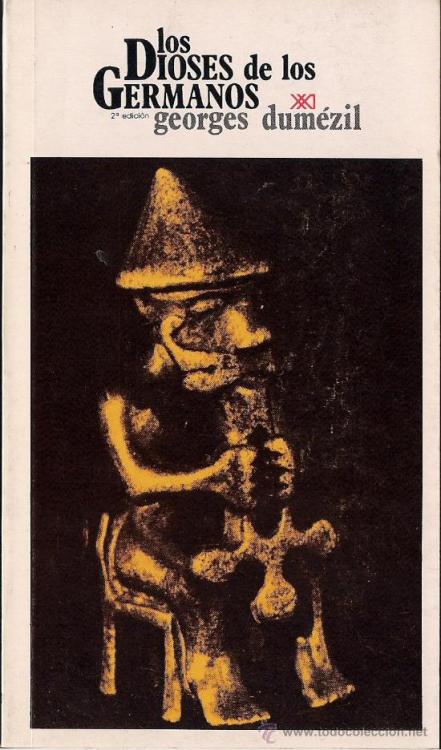


[Spanish edition cover featuring Icelandic Thor.]


Dumézil's trifunctional hypothesis posits that the functions of the gods reflect a society's factional roles, with Odin, Thor, & Frey being the major triumvirate and thus classifying that society's members into rulers, warriors, or farmers, respectively.


Also if modern Indian society is made up of castes, then Dumézil follows that this is a hold-over from Indo-European roles represented by the deities Varuṇa, Indra, & Nasatya, who also have similar functions as Odin, Thor, and Frey, and therefore correspond to those post-migration deities.


Supporting this association, Dumézil shows additional parallels between the tales of Kvasir (a being turned into the intoxicating drink of poetry) and the vedic Mada (a giant who's name means drunkenness), both importantly figuring in the end of a war between factions of the gods (Aesir versus Vanir & the Indian sky versus nature gods), and the Mahabharata's inter-familial struggle of Shakuni tricking Yudhishthira into exile compared to Loki's catspawing of Hodr to kill Baldur among the Aesir (which of course presages Ragnarök, and for the former, the Kurukshetra War).


The author also casts some grim light on the Vanir goddess Nerthus, who according to Roman historian Tacitus' Germania was in a veiled cart and given a procession to visit and bless all the towns before returning to her sacred island. Just before that return however, slaves who bathe the cart & see the goddess are drowned in her lake (!):


"From there comes a mysterious terror, the sacred ignorance of the nature of a secret that is seen only by those who are going to perish." (Tacitus, ch40)


Another reveal mentions the nail in Thor's head depicted in statues (p70), which we'd never run across until finding this illustration online:
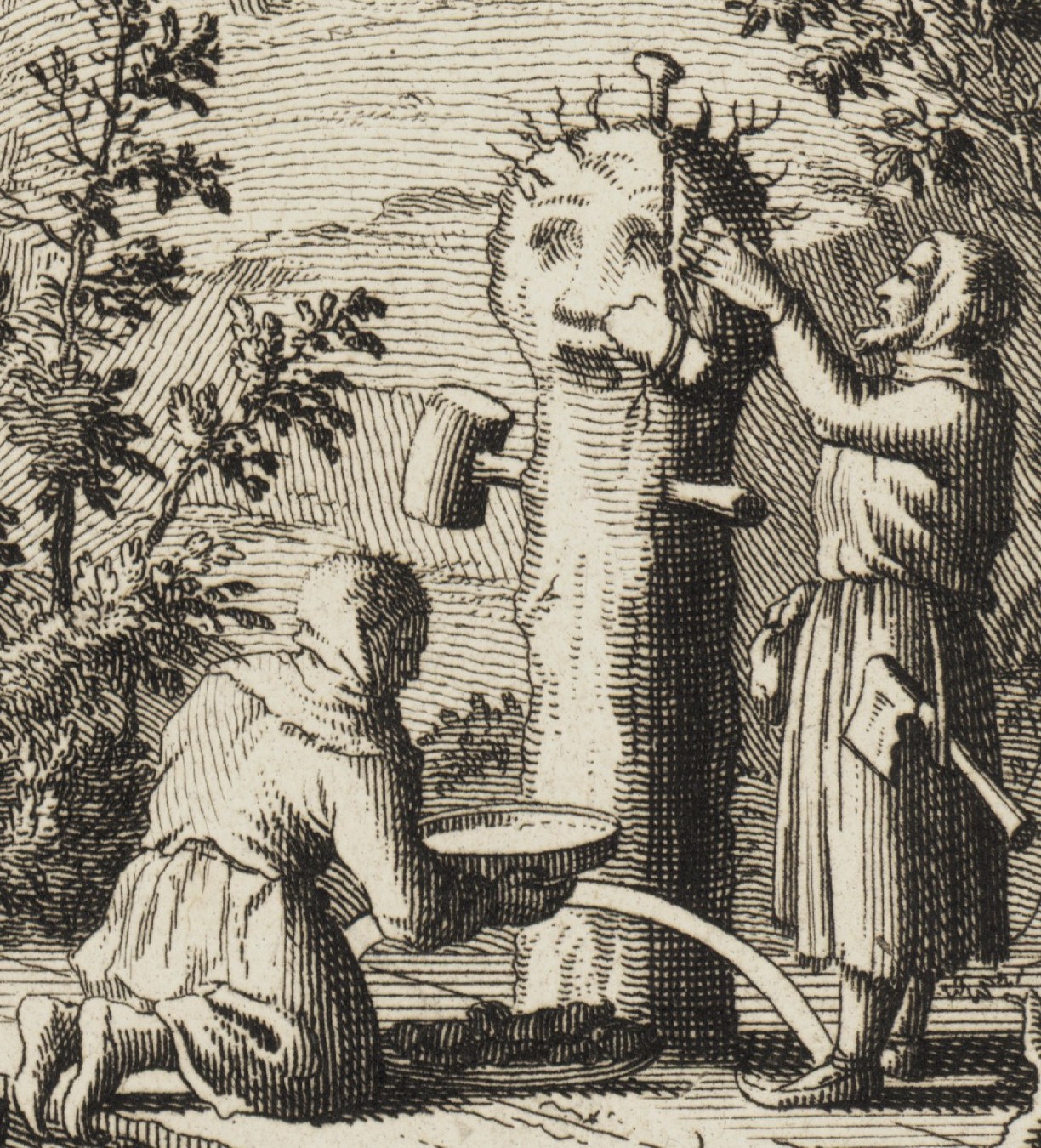


[God pole engraving of Sami storm deity Horagalles ("Thor-Man") with nail in his head hung with whetstone. By Bernard Picart, 1725.]


Dumézil likens the stuck hone from Thor's first formal duel to legendary Irish hero Cu Chulainn's hone-like shaped head "emanation" after his first battle, and would guess that there's a representation of a warrior's rite of passage in this striking similarity.


And Dumézil works out an impressive mental somersault into a what seems to be correct identities for Byggvir & Beyla, two mysterious companions to Frey passingly mentioned in the Lokasenna. From clues in retorts made by Loki, the former male is Barley, and the latter female is the Bee (this conclusion expanded in Dennis Schmidt's erudite & entertaining re-imagining of the Eddas, Twilight of the Gods), both appropriate offerings & personified associates of harvest god Frey.


Heimdall, a god with so many inexplicable epithets, also gets the acute eye of Dumézil's associative reasoning by figuring out that the "whitest of the gods" (compare to Baldur, "brightest of the gods") probably connects with another name for Freya: Mardoll (note the suffixes -dall & -doll), which means sea-light. Heimdall's sea origins come from his nine mothers, the waves, who are the nine daughters of the sea jotuns Ægir & Rán. Sailors say the ninth wave is the roughest, and therefore the most decisive of action, and that many cultures liken the foamy tops of waves to charging white animals. In the case of the Welsh and the sailors' saying, the first eight are ewes, but the strongest is the forceful ram, which gives Heimdall his godly connection with the ram, applicable to his last mother. This is but a few of the explorations Dumézil pulls together on this deity.


Parisian Georges Dumézil (1898-1986) could read Latin by age nine, served as an artilleryman in WWI, earned his doctorate in classics by comparing the Greek divine drink ambrosia with the Indian immortality drink amrita, taught in Istanbul, Uppsala, & France, achieved membership in the prestigious Académie Française, and through most of that time published many, many works on comparative mythology.


Flying in the face of the above curriculum vitae and after reading this study, we feel the tripartite theory is a simplification, an academic's need to place people in boxes using the roles of their major gods to do so. While this mirroring looks great on paper, societies have specialists (i.e. craftspeople, seers, clergy, merchants, scribes, et cetera) that do not fit in such cut & dried classifications. Yet without a time machine or further accounts one cannot discount Dumézil's trifunctional theory. We do note that in old Nordic societies the farmers were also the same warriors who went on viking raids, so while those functions were separate the same individuals did both, as per need or season. Despite this critic's disagreement with the core thesis, there's so much depth & perceptiveness that Dumézil has to teach that even the most hardcore of mythology mavens never knew of, which makes this book so worth learning from.


While there are bilingual side-by-side translations of Icelandic quotations to English, there are also many parts where German, Greek, Latin, French, and others are used but not translated, author & editor expecting their audience to know them. We should be flattered by this presumption, but instead find ourselves quite stymied, and suspect most monoglot readers will be too.


In sum Gods of the Ancient Northmen isn't so much a progression as it is a collection of papers & combined lectures, which leaves no great conclusion, but its amazing examinations can only make us scrutinize & broaden our search for answers.


[One wonders at what other insights could've been discerned if Georges Dumézil had a search engine for his library.]


The individual chapters & exploratory passages all contain great points that are provocative & illuminating. Dumézil's reasonings within Gods of the Ancient Northmen's an impressive thought exercise to get us to continue to think of our divinities in different ways in order to learn more about them -- an intellectual pursuit of insight Odin would totally approve of.


#  #  #


While a mostly happy bookstore fixture for over two decades, Guillermo Maytorena IV is currently willing to entertain your serious proposals for employment as a literary/cinema critic, goth journalist, castellan, airship pilot/crewperson, investigative mythologist, or assisting in a craft brewery. Should you be connected to any of the above or equally interesting endeavours, do contact him via LinkedIn or G+.

Friday, January 3, 2014

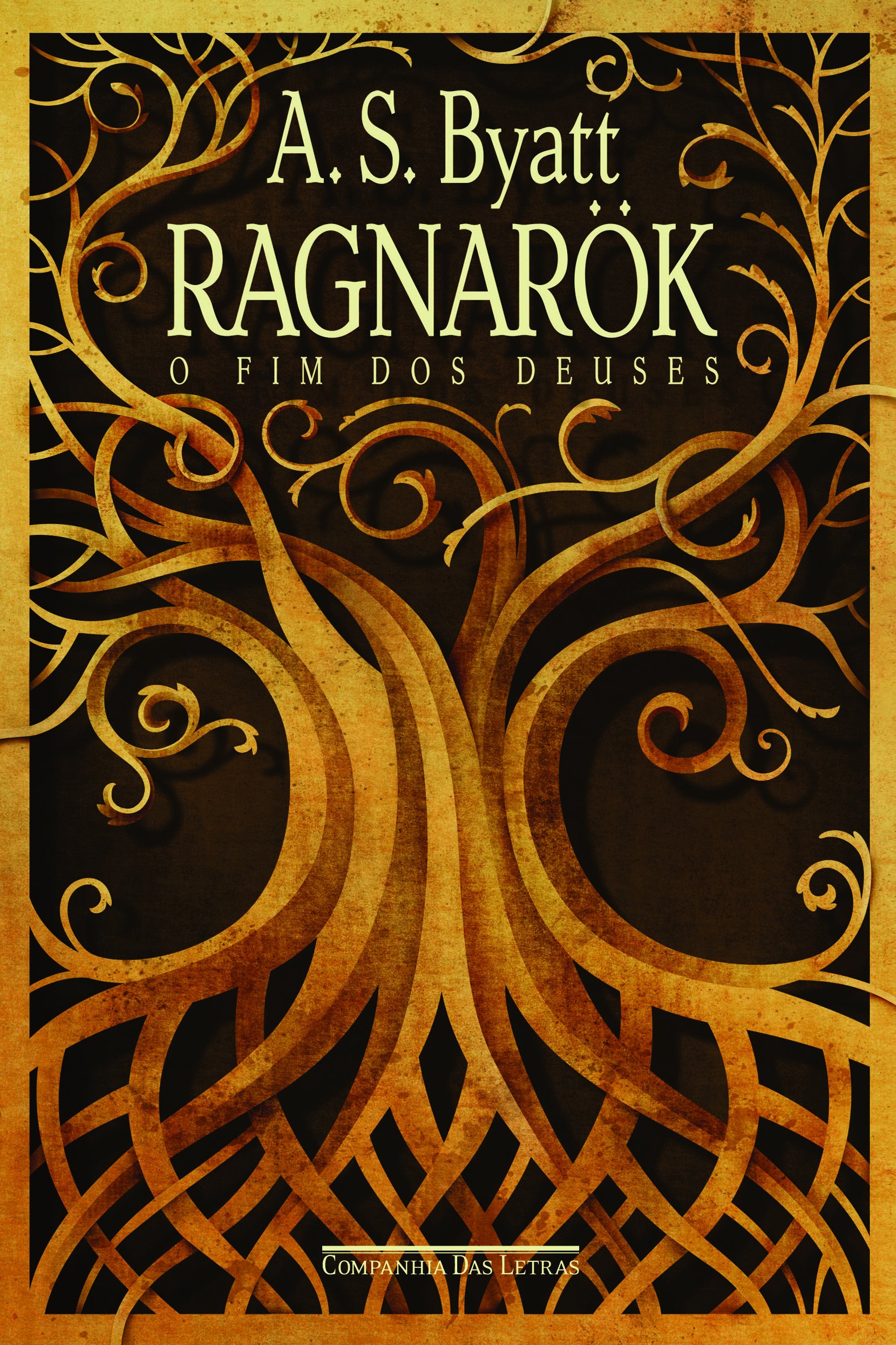
Byatt's Ragnarök: re-purposing mythology.

After reading trendy Eggers' underwhelming recent essay on the D'Aulaires' childhood classic Norse Gods & Giants (which one already knows is wondrous all-ages magic without his stamp of uninsightful approval), running across celebrated A.S. Byatt doing her take on Norse lore was an offering Nine Worlds better.


Known for one of the most refined epistolary novels, the Booker Prize winning Possession (1990), which will rip your heart out and make it pump tears of saddest sad sadness, one can only imagine the Wagnerian angst & pathos such a talent could lend to the verses of the Gods. Yet the tender Possession and the Icelandic skald Snorri Sturluson's mythopoeic collection are also worlds away from each other, and the gap shows at times.


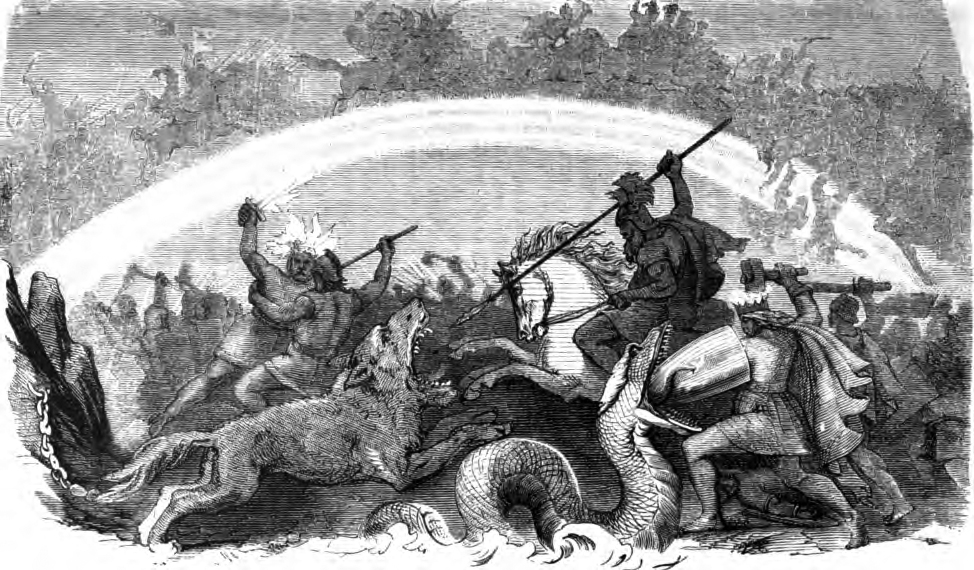
[Friedrich Wilhelm Heine's "Kampf der untergehenden Götter" (1882).]

In Ragnarok: The End of the Gods (2011), Byatt brings her own modern insights into the built-in eschatology of the Northmen. While she's hardly the first one to do this academically or creatively, having her mind turned toward a personal interpretation gives one surprising perspective on Asgard and its gods. While many dismiss Loki as an antagonist for antagonism's sake (or conversely worship him [semi- or even non-apologetically] as a divine medium of difficult change & transformation), Byatt presents Loki less as a god of mischief and more as an explorer of the patterns found in chaos theory, an outsider by nature of his extremely inquisitive, and possibly superior, mind. This also lets us to see how the higher functioning Odin continues to allow his both disruptive but useful presence as a blood brother and travel companion, as Odin may have more in common with Loki on intellectual levels than the others of his heavenly house. Byatt also puts forward the theory that Loki is part of the original triumvirate who creates man & woman from an ash & elder tree, and specifically is able to contribute to the miracle of mankind by transmuting the tree's sap into blood, making him far more integral to humanity's story. She also explains that Odin ascends to be the ruler over his two man-making peers as he sacrifices himself, his eye, and identity, for ecstatic knowledge.


Byatt also a offers a psychological take on the monstrous wolves who chase the sun & moon across the sky as "wolves of the mind", an ever-present built-in idea of the intellect's potential for self-destruction manifest as the ravening creatures that threaten to swallow the sources of illumination in ourselves & the world. Plus she posits that if the wolves weren't there as the clockwork that drives day into night and night into day, there would be no demarcations of time or season without them, and no universal/internal motivators to keep ourselves achieving instead of descending into darkness or lassitude.


Framing all this re-appropriation of the lore is Byatt herself presented as "the thin, pale child", a nameless girl displaced into the countryside by the Blitzkrieg of World War II (much like a Pevensie of Narnia), with naught much else but a copy of a Norse mythology book to give her some strange & fantastic comfort. The child's voice is hardly that of a child, but of our 75-year-old authoress looking back at herself, and at the Heathen legends that fascinated her far more than the compulsory trips to monotheistic church or a secular schoolhouse.


Outside the lines, Ragnarok succeeds as a commentary of amazement with a wonderfilled personal embellishment, an ambitious filling out of the cosmology. Most inventive is Randrasill, the undersea skeletal analogue to Yggdrasil, her construct equally full of life, giving the reader a deepwater survey of the aquatic legion that surrounds Midgard. Exiled into this world by Odin, Byatt also performs another first by presenting a POV from world serpent Jormungandr, and adding scenes of Loki's fathership in raising his daughter from simple sea snake into an ominous ouroboros.


Less than these two inventions, Byatt lends her explanations to the Baldur story. One always questions that if Baldur's death means the worlds' end, why would the gods make a game of throwing potentially deadly things at him? Yet once the gods come up with it, "Hit the Baldur" isn't just an afternoon novelty but the best-game-ever invented, and they find they can't stop from playing. One also questions why if Frigga went through the trouble of ranging the whole of the Nine Worlds to obtain a promise from everything animate & inanimate, how did mistletoe get neglected? We find that mistletoe appeared in the world just after this infinite contract was closed, that it was still childlike and "too young to make a promise", leaving its innocence open for Loki's manipulation into a weapon.


When Ragnarok does unfold, another in-battle perspective Byatt presents is that Thor doesn't realize he's been poisoned until it's too late, turning to brag to the Aesir that he bested his nemesis and lived, only to fall to the venom on his ninth & very last step.


[Marvel Thor is not amused.]

Vocabulary of note is the repeated use of the fatalistic word "ineluctable", and the admirable neologism "ur-book". ("Ur-book"! Wow!)


Conclusions? Ultimately there's no payoff with the Nazi threat, or the conflict inherent in her Germanic heritage, or a ratification of a Heathen worldview, so the framework for the storytelling's inconclusive as it never comes back around to the pale child who is Byatt in any satisfying way. There could've been a sort of Teutons versus Angles call-forward, an examination of the "wolves" that drive the conflict of war, like natio/tribal fascism, and comment on the necessity of preparation for war, but none of these ideas are ever truly exercised.


Byatt uses parts of Ragnarok as an allegory on our inability to save the world, to change our story, and in her afterword goes so far as to place her interpretation's concern for the world as an ecological one, which is a thoroughly modern use. The disconnect here's evident: Byatt's contemporary purpose is not the timeless purpose of the lore. Not to say that the Norse creation/apocalypse doesn't contain everything (oh it surely does), but the tenuousness of physical existence more reflects man's barely sustainable grasp in a world of forces that defies his daily living with an unrelenting ice & harsh frost that deny him resources and its impact on him, as opposed to his impact on it. If one can bypass this mis-inversion, there's alot of other grand exploration to be had in Byatt's otherwise earnest rendition the Norse lore. Like in Possession, there's a strong lifelong and even more cosmic love here that cannot be denied.


#   #   # 


While a
mostly happy bookstore fixture for over two decades, Guillermo Maytorena
IV is currently willing to entertain your serious proposals for
employment as a literary/cinema critic, goth journalist, castellan,
airship pilot/crewperson, investigative mythologist, or assisting in a
craft brewery. Should you be connected to any of the above or equally
interesting endeavours, do contact him.

i miss my dead dog ... so what am i?

I fucking miss my dog. I miss him so much, my packmate, Buddy Guillermosson. And the thing is I know, I know he's having a good time, ...