Search

Showing posts with label vampires. Show all posts

Friday, December 26, 2014

crowning Prince Lestat.

It's the undead high school reunion you've been waiting for. Or rather the secret vampire club hidden inside your high school you felt you belonged to, whether you first discovered Interview with the Vampire as a curious little paperback in 1976 or climactic The Queen of the Damned in 1988 or the ambitious cosmological heresy of Memnoch the Devil in 1995. Prince Lestat of 2014 is the offering you never thought would happen again after Anne Rice's re-embracing of Catholicism/Christianity after the second major death in her life. But the undead never die, lucky us.


This eternal return is complete with everything you remember: the hand-to-forehead, tragically blessed soulful vampires, effete & elegant, as Anne Rice first redefined them. Worshippers of beauty who see the world through the lens of night whose existence is sustained by life itself -- blood. By now these ideas popularized by Rice are decades old, have birthed and faded RPGs/LARPs, A/B film offerings, and countless diaspora in the horror & paranormal romance & urban fantasy genres. Ergo, you may suspect that the original characters and their behavioural conceits parody themselves by now. Yet while Lestat & Co are the same vampires, the 21st century is certainly not the same world they've spun their many memoirs about, nor does the current challenge that faces them allow for things to remain unchanged.


The creeper vine ornamented Prince Lestat UK dust jacket.

In this, the best aspect of Prince Lestat is its return to the dynamics of the mythology Rice invented, filling in early vampiric history of Akasha's Queen's Blood faction versus the twins' First Brood, and how such factions may effect how some of the ancients see each other 6,000 years later. Part of the big success of the series has to do with giving the reader a dark secret they can savour, and it could be argued that once the origins were handed out over the course of the first three books, the latter-day secrets in the rest didn't have as much gravity, but what unfolds in this latest book definitely delivers.


And if you enjoyed the narrative structure of Queen of the Damned with its assembly of the cast before the third act, then you'll cotton to Prince Lestat. The cavalcade of new names also implies the possibility that Prince Lestat's but the first of many more installments.


One can't help but notice a disconnect from 2003's Blood Canticle, where a less than isolated Lestat actually does pull himself away from his spiritual ennui long enough to help out the Mayfair clan Rice features in her other witch-centric series. Instead we're again given a Lestat still claiming he's almost damaged beyond hope, who loathes contact, and cares not for what happens to his peers. This works for the arc of the book, but proves partially incongruent for the series.


Rice points out that the literature of the vampire is a cultural vessel, that these texts provide answers & context for the undead as well as their mortal audience. In a metafictive way, Rice self-references the impact of her own books in her vampires' world & in the real one in terms of exploding the genre with her inspiration. It's a brag, but one fully backed by overwhelming success, and the establishment of an unassailable re-dressing of the vampire archetype.


As the plot inevitably brings characters together, Rice uses an interesting operating metaphor: The meeting of the vampires is like death, a reunion of souls long thought lost forever to one another. Rice implies that such an un-afterlife's akin to being with our lost loved ones (i.e. wishfully her daughter Michele & husband Stan), also complete with physical manifestations of ghosts.


More importantly Prince Lestat again advances vampires by positing a cultural evolution of the collected outsiders accepting themselves for what they are, divorcing what negative terms humanity may have contexted the vampire, and finding contentment in that realization. They begin by confronting that they're not dead, but alive, not damned, but blessed, and to still hold onto the medieval ideas that defined them only keeps them from feeling they deserve to be more than monsters. Granted, this self-forgiveness doesn't mean they're no longer vampires ... and for that sanguine truth -- that the blood is the life -- we are thankful.


While a mostly happy bookstore fixture for over two decades, Guillermo Maytorena IV is currently willing to entertain your serious proposals for employment as a literary/cinema critic, goth journalist, castellan, airship pilot/crewperson, investigative mythologist, or assisting in a craft brewery. Should you be connected to any of the above or equally interesting endeavours, do contact him via LinkedIn or G+. 

Friday, January 17, 2014

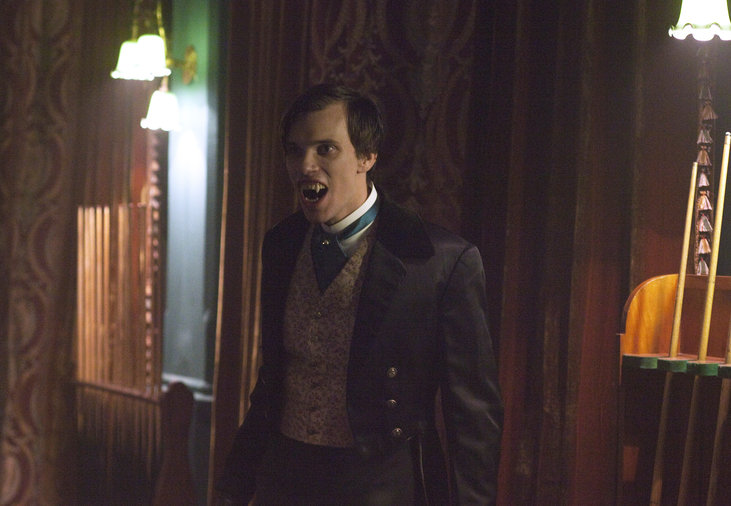
NBC's Dracula: Episode 9, Four Roses.


The three single stems Alexander brings hospitalized Mina are obvious. It’s this episode’s eponymous fourth rose that blooms when Dracula says, “If you’re going to behave like a monster, then I’m going to make you one”, as the story finally has Lucy get turned, but in an act of hatred over the original one of desire. Yet, if you’re going to shoot a bloodletting & bloodgiving scene in a picturesque milk bath chamber you’ve already spent tons making & lighting, use the contrast of liquids, and the blooming infectious cloud of blood permeating the milk in an overhead shot. Instead they chose neck gore over subtle cinematic poetry.

Also this episode continues the trumping up of Lady Jayne’s concerns about an increasing vampire incursion in London. If there’s an epidemic of ghastly proportions infesting the whole metropolis, let’s see the rolling of victims, a pub takeover, dead bobbies as the corpse of authority, or dirty street urchins strewn about like empty bags that were neither cared for by Victorian society alive nor dead ... but they certainly would when they rise undead to feed on them.

Instead we do get one scene of Dracula leading his “relatives in from the continent” to take out some of the lesser known Order of the Dragon, but despite their awesome damask waistcoats, they’re just not-so-elegant hissing monsters sporting unfortunate bulgy mouthed dental prosthesis.


[No, why bother hiring an accomplished professional fangsmith like Dnash, when one can cut corners with huge plastic caps? It’s only a really expensive & risky primetime major network show with tenuous ratings.]

And Mina’s reflection vision of herself as Ilona in the gutter scene, while a good idea, terribly bad execution. With so much sophistication plotted and built one minute, there’s hardly much time wasted in yanking the carpet out from under the same foundations. It’s surely unintended, but at times one feels that there’s a “oh, that’s good enough” ethic that erodes the result.

Plotwise, things only set themselves up for what may just be an anticlimactic end of season: Harker ensconces himself with the Order of the Dragon, continuing to prove he’s the biggest patsycake ever. And in another echo of past things, Mina throws Lucy out of a whole hospital upon Lucy’s passive confession of jerkface Harker’s tryst.

More interestingly, Mina’s modern directness gives Alexander the opening he needs, her admitting to inner knowledge she’s metaphysically connected to lost Ilona, but in a fit of vampire guilt, Dracuxander doesn’t take the opening by finally confessing his love. It’s a great moment hampered by unnecessary restraint, especially since Davenport’s threat’s been removed from the board. Also mentioned by Lady Jayne, the “Sanguine Sanctorum” has been loaned to her team of hunters from the Vatican. Whatever this item is, we’re dying to find out.

And most vengefully rogue, it seems Van Helsing may have injected Browning’s kids with his apothecary jars of Dracula’s blood before deciding to ransom them for £50K (oh, about £21M today!). If the implication of the syringes is correct, the series’ creepiness factor may multiply “‘Salem’s Lot”-style with Browing either getting eaten by his own offspring, or being put in the position of having to drive steaks through their tiny hearts! Well done, Van Helsing!

With Harker’s granting the Order the blueprints to Grayson’s transmitter, it seems hopeless that a big science ending’s going to prevail. Browning’s demands for a catastrophe may happen on both sides, and one has to suppose that a fat cliffhanger full of debris and smoke’s all we’re going to get … unless Dracula placed faux plans for Harker to steal, but that’s probably overthinking it.


While a mostly happy bookstore fixture for over two decades, Guillermo Maytorena IV is currently willing to entertain your serious proposals for employment as a literary/cinema critic, goth journalist, castellan, airship pilot/crewperson, investigative mythologist, or assisting in a craft brewery. Should you be connected to any of the above or equally interesting endeavours, do contact him via LinkedIn or G+.

Friday, October 25, 2013

dividing The Twelve.

Society embraces different monsters as it needs them.


Romero's cinematic commentaries on self-devouring brainless consumer culture aside, our financial dead end post-2008 GFC finds people on some level longing for the zombie apocalypse to nullify personal debt and shed the mundanity of their lives for a more videogame/comicbook survival scenario.


I still vote vampire party though, since I'm a Lost Boy of Rice's 1980s.


We know in our hearts that zombies are too stupid to take over (yes, even if they were able to run), so it's a safe dark fantasy for society's tasty little rotten brains to enjoyably scare themselves with.


But with vampires, or zombies, or any monster, it's what would you do in the face of the threat. As readers/viewers we constantly play that game, either being underwhelmed by what dolts the characters are (i.e. many of Stephen King's Mainers), in agreement with, or at best, surprised & astounded by their monster coping adaptations, and Justin Cronin's The Twelve delivers the survival scenario in deadliest spades, never insulting us with simpletons but gifting us people who can deal not only with an irreparably fractured nation but with a harder version of humanity.


[Mas Gothic UK cover.]

A sequel to 2010's runaway bestseller The Passage, the setting/voice/tone's 99% existential survivalism. The world doesn't give a fuck & it'll turn on your irrelevant sense of self-importance like an angry dog the moment you even think about looking in the mirror too long. And when your reflection does bare teeth, it unfolds like a slow motion nightmare where the dread of inevitable disaster is coming, the description stretching taut until the final whiplash moment of consequence. Hive-minded insectlike vampires über alles, with rather unhappy & small enclaves of dispossessed humanity just sustaining, and never really able to honestly hope in the face of abject terror.


Opposed to that existentialism, the other 1% hints at an unstated intuitive connective tissue that happens in life's exceptional moments: "At the wheel of the Redbird, Danny Chayes was experiencing, for the first time in his life, an emotion that could only be described as a magnificent wholeness of self. It was as if he had lived all of his twenty-six years within an artificially narrow bandwidth of his potential personhood, only to have the scales fall abruptly from his eyes." As with magick/seiðr, or active meditation, there's perceptive empowerment, transcendental, but not in the dwarfing in the face of nature way, more in the Kabbalistic godding way, as if the desperate times evoke & evolve in us exceptional self-measures, as per Colin Wilson's thesis in The Occult.


Cronin comes dangerously close with mentally disabled Chayes & victim/victimizer Lawrence Grey to King's Trashcan Man, using the trope of the ancient child/Boo Radley figure, and moreso in this sequel are there moments where one compares with The Stand, and some structure of Yvonne Navarro's far lesser known Afterage (1993). While this book wouldn't have been buildable without King's diseased decimating whimper end scenario from 1978, Cronin surpasses that ploddingly slow gathering with intelligent characters, breathtaking fear, and far grimmer circumstances. The absence of humanity and decay are prevalent in both.


In the face of apocalypse all the mundane details that daily living leave gain sweetly tragic gravity: "They backtracked into the heart of the little town. All the lights were out, the streets empty. They came to the school, a modern-looking structure set back from the road at the edge of the fields. A marquee-style sign at the edge of the parking area read, in bold letters: GO LIONS! HAVE A GREAT SUMMER!" America, R.I.P. School's out forever, indeed.


As a first installment The Passage completely shocks us with a new scenario and unguessable progression throughout, but The Twelve shows us different aspects of the aftermath and what gets cobbled together in greater swaths than its predecessor. One could probably get away with not reading The Passage and just read The Twelve as Cronin goes back to the outbreak and sets up the vampire dominant situation again, but you'd be compelled to go back and read The Passage too.


One moment where Cronin does totally cheese out though is at a stadium. We're told that something really, really, really³ bad's happened there, but we never actually get to see it. Implication's far from enough in this instance, and whether the author thought he might alienate his audience, or felt that he might be playing too much horror too early in the story, I'm unsure of, but the lack of delivery at that moment was sharply, sharply, sharply³ unsatisfying.


Far outnumbering that are the many, many, many³ moments of solid writing & craft, such as this "waiting" paragraph that's so pure gold: "He waited for orders; he waited for chow; he waited for the latrine. He waited for the weather to break, and when it didn't, he waited some more. Orders, weapons, supplies, news -- all were things he waited for. For days and weeks and sometimes even months he waited, as if his time on earth had been consecrated to the very act of waiting, as if he were a man-sized waiting machine."

"He was waiting now." Ha!


Also smart stylewise, Cronin slips effortlessly at the right moments into King Jamesian language to heighten the sense of circumstance & climax. We are reading an account of the apocalypse, like the Book of Revelation, or a doom-poem Ragnarok, our future itself set down for us to gawp at, and at certain junctures Homeric epithets get prefixed & suffixed to names, and destinies are nailed to flesh, and made heroic or tragic. Plus the inverted parallel between the original apostles that spread the word & miracle, and the 12 original vampires of the title suits this choice.


Cronin may be an NFL fan since the end sequence resembles a football game, but more like the Mesoamerican ballgame, the stakes are life & death, and results possibly world altering. The main antagonists are built up in both novels, but here we still don't get enough exploration of them before that climax, which in a third person book like this could've been presented, but wasn't. In contrast of the Ricean literary innovation of personalizing the vampire that we've gotten to unlive vicariously though, there isn't too much given here on our fanged overlords, but I suspect that may await us in the third book.


And the rules for Cronin's insectoid vampires are both familiar & shudderingly different. Remember the first time you read Mark Rein·Hagen's adaptations for VtM? There's something of that in here, a rooting of the Underworld franchise's science with preternatural manifestations of Stokerian ideas, which give us something fresh to consider in a subgenre rife with imitation.


The Passage Trilogy completes with 2015's The City of Mirrors. I'm hoping for a far future narrative jump. You've taken us so far afield Mr. Cronin, into the glimmering midnight that tests our ability to endure as a species, and makes us wonder if we each have what it takes inside to live until tomorrow.


[enter The Passage.]


#  #  #


While a
mostly happy bookstore fixture for over two decades, Guillermo Maytorena
IV is currently willing to entertain your serious proposals for
employment as a literary/cinema critic, goth journalist, castellan,
airship pilot/crewperson, investigative mythologist, or assisting in a
craft brewery. Should you be connected to any of the above or equally
interesting endeavours, do contact him via LinkedIn or G+.


Monday, June 28, 2010

the undead subtract the subjectivity of math.

"Vampires a mathematical impossibility"?!?


If physics professor Costas Efthimiou thinks he's so damned clever, why isn't he working on applied fusion, as opposed to pulling this cynical nonsense to get his name in some third-rate science website's well-buried Halloween feature article? Publish or perish, indeed. (What's also odd is a dead link from his homepage to Transylvania University, and vacation pictures of the Greek islands -- an alleged hotbed of vrykolakas activity! Is he really a disinformant?)


Math relies on unproved postulates to complete its geometries, and resorts to imaginary numbers to solve its problems, while even Euclid's unreal linear thinking unravels and frays when distances inevitably curve. If some number zealot needs to go comfort himself under spreadsheets of theory so he can feel safer at night, then let him fool himself. Anyway, Efthimiou's based his formula on a zombie mechanism, not a vampiric one. Single vampire bites do not necessarily spread the blessing.


Stoker's Van Helsing, yet another self-proclaimed "Mr Know-It-All", was partly deceived the by this same misconception: "... they cannot die, but must go on multiplying the evils of the world; for all that die from the preying of the Un-Dead becomes themselves Un-Dead, and prey on their kind. And so the circle goes on ever widening, like as the ripples from a stone thrown in the water." (pp. 263-264, McNally & Florescu, eds.), which is likely where the mathmonkey drew his flawed timestables from. Plus, the idea of vampirism's been around for far more than 400 years, as paintings on ancient Assyrian pottery suggest. And by the time numerous official military and medical accounts of vampirism crashed upon the intellectual shores of the Ages of Reason & Enlightenment, it was none other than philosopher Jean-Jacques Rousseau (1712-1788) who had the illumination to conclude: "If ever there was in the world a warranted and proven history it is that of vampires."


Maybe Count Vladislaus Dracula in 2004's "Van Helsing" encapsulates it best: "Why can't they just leave us alone? We never kill more than our fill. And less than our share. Can they say the same?" Only stupid hunters shoot all the game, while the smart ones care to leave enough for next season, and vampires aren't required to kill their prey like humans, monthly or otherwise.


Leave the vampires to the vampirologists, and go say your faithless rosaries on the abacus you litanical mathematicians, because undeath defies not only math, but the limitations of life itself.


[From a long-ago blog, re-posted/re-contexted here in honour of the recently deceased Jerry Nelson, the voice of Sesame Street's Count Von Count. His character lived the folklore that vampires are possessed by a compulsion to count grains or thistles, a facet that could be used to stymie pursuing undead or delay their entry into homes. But for The Count it was not only a teaching technique but a joy that seemed to celebrate his infinite nighttime existence, a creature beyond the rational using the rational to sum up the world around him, and arguably the happiest of characters on the Street. Thanks for all the love of countless things in life & unlife, Mr Nelson.]


#    #    # 


While a mostly happy bookstore fixture for over two decades, Guillermo Maytorena IV is currently willing to entertain your serious proposals for employment as a literary/cinema critic, goth journalist, castellan, airship pilot/crewperson, investigative mythologist, or assisting in a craft brewery. Should you be connected to any of the above or equally interesting endeavours, do contact him via LinkedIn or G+.

Wednesday, September 9, 2009

Underworld is the Star Wars of vampire movies.

"Underworld" surpasses the idea of the creature feature. It personalizes the horror the way Anne Rice did, additionally throwing it back out into a greater context of conflicts. It's not just "Dracula vs the Wolf-Man", an indefatigable will slugging it out against uncontrollable beast -- it's an implication that these forces secretly dictate the workings of man. Michael Corvin's journey is the discovery of the darkness that underlies the mundane. And despite his every noble intention to practice medicine and save lives, the dark is in his blood and it's in our blood. This uneasy truth is what makes the film important & significant.


As primary example the first film gives its viewers Selene, a vampire warrior, a monster you root for and identify with. "Hunt them down and kill them off, one by one," Selene states as her joy. "I lived for it." Selene's accepted her darkness, using its inherent strength for a centuries long crusade of vengeance, and the virtue of that darkness attracts Michael. Corvin could instead turn his interest to the girl he helped save from the subway shootout, but the obsidian shadow he detects in himself, and in the nature of the world, appeals to him more.


While this edgy theme's the most insightful reason a studio-backed small budget film of $27 million unexpectedly garnered so much commercial success that it was re-issued in a sexy slipcased double DVD Unrated Extended Cut, there was quite alot more to it than that.


There's the litigation framing the picture to consider: White Wolf, makers of a roleplaying game wherein vampires & werewolves also happen to be bitter enemies, sues media giant Sony Pictures -- a losing battle. What the RPGers in Stone Mountain, Georgia, later forgot as the money kept rolling in over 13 prolific years was that they too built upon the mythic edifices which came before them: Augustine Calmet, Montague Summers, Bram Stoker, Richard Matheson, Whitley Streiber, Marv Wolfman, and of course Anne Rice. Director Len Wiseman denies he & his co-writers had any familiarity with the game, which is a legally safe answer (as legally safe as White Wolf stating their gaming books had no bearing on the vampiric murders committed by Roderick Ferrell in 1996). But even if writers Wiseman, Kevin Grevioux & Danny McBride had read the RPG sourcebooks, they took the archetypes and made them their own, exactly as all their predecessors had done, which is why there's a common set of similarities. The major divergence is the scientific: that both vampirism & lycanthropy spread from a mutagenic virus that only a small percentage of victims are susceptible to, cleverly accounting for why the mortal population hasn't been converted in epidemic proportions, and also why the urban decay endemic to the setting's ever present.


Plus, there's all the offscreen drama within the drama. Kate Beckinsale, respected for her roles in historical films, works against type by signing on to "Underworld" along with her longtime live-in boyfriend & father of her child Michael Sheen, who plays Lucian. While acting together might seem designed to ensure domestic tranquillity, during filming Kate and director Len Wiseman connect, and the British tabloids have a field day with the triangle as Kate relocates to LA to begin a new life with her new man. All this tension must have been channeled into the performances. When Lucian chases Selene's car, catches up to it, and punctures the roof with his sword to bury it in her shoulder, perhaps we're not just seeing a werewolf attack a vampire -- maybe we're witnessing a former lover stab his ex-girlfriend with relish as well.


A few months ago while waking up to one neighbor's brood cavorting on their back porch, my first reaction while lying in bed was to wish all the brats a painful loss of feet & tongues. "Hiss! Hiss!" a boy said. Then, "I'm a vampire!" And the girl also suddenly empowered said, "Now I'm a vampire too!" It made me want to go to Lown's and get all of them a pair of those cheap plastic fangs (but then I reconsidered as it might change their fearful impressions of me as the Goth next door). This mass influence, context & insight is why the 2003 "Underworld"'s achieved such cult status, meriting its hard-hitting 2006 sequel and this 2009's third medieval installment. Like the vampire, they will endure the test of time.


[Amelia, look out!]


#    #    # 


While a mostly happy bookstore fixture for over two decades, Guillermo Maytorena IV is currently willing to entertain your serious proposals for employment as a literary/cinema critic, goth journalist, castellan, airship pilot/crewperson, investigative mythologist, or assisting in a craft brewery. Should you be connected to any of the above or equally interesting endeavours, do contact him via LinkedIn or G+.


Friday, March 3, 2006

Fetishy Barbarella for the New Millenium: Ultraviolet Ultra-Disappointing.

"Ultraviolet" ramps up with a title sequence of nonexistent comic covers, showing adaptations of the action heroine drawn in styles from golden age through modern. Unfortunately the film itself more resembles a gutless Image title -- all arty flash with only semblance of substance.


Set in a technologically advanced late 21st century where a biolab accident has created a highly contagious race of blood-drinkers, a civil war ensues between humanity and the new breed of faster, stronger hemophages. Guarding humanity from the forces of infection is Vice Cardinal Ferdinand Daxus (Nick Chinlund of "Desperate Housewives") who creates an antigen that will wipe out their vampiric adversaries. Enter Violet (Milla Jovovich), who will stop at nothing to save the oppressed hemophages from destruction. Neither side comes across as likable however, even if the vampires are better dressers.


Model/singer/actress Jovovich brings the experience of "The Fifth Element" and "Resident Evil" with her as the heinie-kicking hottie, and there's no lack of her in skintight apparel shooting, cutting, and mad-dogging thousands of faceless guards. Loaded moments play her as an over-the-top fetishy Barbarella for the new millennium, but none of it is enough to support the film's shortcomings.


[Okay, that sword's admittedly bad arse.]

"Ultraviolet" unapologetically borrows from many successful films, including "The Matrix", "Underworld", and even an element from "Pulp Fiction". Supersaturated digital grading imparts an airbrushed look to everything, which is so heavy at times it gives a "Tron"-like appearance to the setting, nicely complimented by a neat techno-orchestral soundtrack. But for all its slickness, the story shows its cards halfway through to become predictable. And as soon as that happens battles lose their dramatic impact, the characters flatten out, and enemies meet their demise -- so why even care?


Given a few more screenplay treatments this movie could have been exceptional, and there's the shame of it. Instead, it was ultra-disappointing.


#    #    # 


While a mostly happy bookstore fixture for over two decades, Guillermo Maytorena IV is currently willing to entertain your serious proposals for employment as a literary/cinema critic, goth journalist, castellan, airship pilot/crewperson, investigative mythologist, or assisting in a craft brewery. Should you be connected to any of the above or equally interesting endeavours, do contact him via LinkedIn or G+.

Sunday, October 9, 2005

The Rita Fragments.

Note to the Editor: There are a couple redundancies in these entries but you've asked for the fragments as is. I thought of editing the similar statements out, but then leaving them shows the persistence of my holding the idea over time in the separate accounts. I'm not sure which is more important, but if as a reader with the editor's eye you find the repetition more obvious than emphatic, let me know & I'll chop the lesser of them out. This is, of course, if you find this whole thing acceptable.

~ gM4


* * * 

From the bookstore forum:

05.13.05 

"haunted when the minutes drag".

So I'm in the can upstairs minding my own business, when the lights turn off. Fumbling about with my pants I get up and cross the room to discover the lightswitch has been moved down, yet the bathroom door is still locked, and of course I am alone. Or was I?


Hearsay has it that when Grant was but a humble grocery store a young lass named Rita tripped and snapped her neck at the bottom of the stairs. Since then Granties have felt her presence, found the phone music turned on in the empty conference room at the end of the hall, and a lucky handful have even seen her standing near the stairs only to vanish an instant later. And very few days go by where someone doesn't misstep on that same fatal staircase and barely avoids history repeating itself. 


One staffer gives account of a Darke Man suited up 1940s style with a chilling aura appearing & disappearing in the Kids' room as well.


Would like to suggest that we take these two souls with us when the Grant store moves downtown. Transplanting a small chunk of kids' room concrete & our bottom stair should prove enough to rescue them from oblivion.


The living now number as many as the whole host of history's dead. Despite this, the dead still have the advantage. Anything could have happened to me during those moments in that darkened bathroom after all, but I think Rita likes me. May the Phoenix staffers find equal peace & respect with their hauntings. Otherwise I hear salt or spit sometimes work, but don't bet on it.


Memento Mori ~ 

Sñr Guillermo the IVth


"If you stay in the Center 


& embrace Death 

with your whole Heart 

You will endure Forever." 

~ Lao Tzu 

Tao Te Ching 

ch XXXIII


* * *

From the Dark Diary: 

11/23/01 11:17 pm

It comes together while driving to my girlfriend's like Beethoven's roaring silencio at 29: the rabbi's tapes said that the dead are not to be feared (for the most part) unlike the horror movies would have us believe. Since they've passed into a state of permanence some of their characteristics become fixed. Rita can trip people on the stairs, turn on the music in the back room, and sometimes flick off the lights in the bathroom. The old tenant in my apartment can open cupboards. Angie's milkbottle presence can follow people down the hall and make its presence known. But they repeat these instances over and over again like other ghosts because that's all they can do -- it's the only way left they have to manifest, and it's also how they’re bound. That's why people who are at haunted sites see the same things. Their choice to do otherwise has been taken away, as the rabbi says only the living get free will and choices. This idea makes sense, but the reality's not as rigid as all that. The dead can be malign like Angie's winged hallway wraith, and can affect the living adversely even though their means of doing so might be limited. Your free will also might be the answer to the question "Why do the dead hate the living?" in some cases. They resent us because they can no longer choose, or they resent having to watch some of us make the same mistakes they made and they can no longer affect this, or they wish to thwart us in these choices and hate that they cannot.


Take these theorems and apply them to the vampire: a being has passed into a state beyond death into an immortal coil, but because it lasts forever it must perform a certain action -- feed on the living. That is the vampire's repeated manifestation. In this, the Strigoi has no choice.


* * *


[Not Rita, but some other ghost on some other staircase.]


***

From email: 

Subject: the Seen & Unseen 

Date: Mon, 01 Oct 2001 16:31:03 -0700 

From: Guillermo the IVth 

Organization: Club Golgotha 

To: "A.G." <--@-----.com>


Bearer of the Spirits A---- ~


It's not just the ghosts; there are things above & below us, infernal & divine. It is written that a third of the angels, a rebellious 133,306,668 of them Fell, leaving their stations as intermediaries from us to god, to think for themselves, to serve and pursue their own desires -- & some still cater to ours but in a different fashion.


Also a balance has been struck in terms of population: the current living equal all the world's Dead, and so now for every one of us there is one of them.


"If the eye could see the demons that people the universe, existence would be impossible." -- Talmud, Berakhot, 6.


These and the ghosts and angels (or what we've culturally decided to name them) aren't agents of anything so ordered as karma or destiny, but more interested parties of the Blessed & Damned, either to aid or hinder or just watch. Mine provide protections over & under me, and I'm thankful to be within their aegis because I know they want me to be here, and my sense of permanence reflects their intentions.


Everyone at work trips on the stairs, teetering to repeat that moment where Rita lost her life at the bottom. Does Rita want company? Does she just want to know that someone can be as unlucky as she to suffer such an empty and stupid Death? Or is it not even her, just the echo of the moment reaching to the present? (The last is a theory proposed by some physicists who say places retain intense emotional energies [like alpha waves] that influence the now. But Rita's there -- she turned the bathroom lights off on me once, and every so often I'll go to the conference room and the background music will be on at full blast coming from the phone, but the lights will be off and nobody's there at all. She just wants something to listen to, or someone to come in back and be in the dark with her for a moment.)


In my apartment cupboards slowly swing open without aid of my hand, the same shelf has fallen 3 times in the past couple months, and my sugar skull recently split apart for no apparent reason. Maybe the former tenant still doesn't know he had a heart attack here. Maybe he does and he's still angry about it, and this is all he can do. Maybe he just needs some attention from time to time so he can stay.


Poe (the singer) placed samples of her late father's last lectures from tapes that she found in his attic into her songs on her last album, "Haunted", and contrasts them with samples of a little girl's voice that is supposed to be hers. It's clever and creepy at times.


My mother's father, Cippriano, visits her. Alone in bed, she'll feel somebody come to sit down on the mattress but my father's not home. And she has a reoccurring dream that he was buried alive, and is still there in the ground trying to get out. She still dreams this dream after 30 years, and it's something she's learned to live with.


Existence is significantly different for the Dead, with differences in time, thought process, manifestation, need, and these factors as well as our own sensitivity and accessibility determine if and when we can perceive them.


Some metaphysical systems state that our souls suffer a second Astral Death. We stay lost here for a time as ghosts, but post-Death the "silver cord" that binds us to our physicality in life has been severed and in its absence the energy that makes up the Soul, which is now untethered, disperses and we meet a more final oblivion -- unless provisions or circumstances ensure otherwise.


Outside of Chicago there's a small town where lies the tomb of the Massochs, a trio of brothers who were butchers (professional not criminal) early last century. In the 1960s their rest was desecrated when someone broke in and took one of their heads. The culprit was caught and punished, the head returned, but since the event a woman and a decade later a girl were found near the crypt, alive but suffering huge blood loss. Other lesser incidents also occurred: a gang of camping bikers was scared away by someone, a dog was found dead, what appeared to be a gigantic "black worm" flew forth from the keyhole at a ghost hunter.


The property was made private.


In 1998 while visiting Chicago I drove out to Spring Valley near sundown and asked in the town until someone was kind enough to direct me there. Set 30 yards away from a bend in the road sits a group of graves in the wood, the mausoleum being the only above ground gravesite.


Waited two hours until I could barely see in the gloaming darkness.


Near the end of that vigil, the sound of scraping came from inside and for a few breathless seconds my heart stopped. A little later I went back to the car to get some paper and in a slot-like hole in the upper western face of the crypt placed a letter to the Brothers requesting audience, and bloodied the paper so I could later be found.


The pictures I took didn't come out.


These things, the daemons, ghosts, angels, Undead, are inhuman, either more absolute or abstract in existence as we know it, and some possess a supernature and qualities that are transferable. We sense this monstrousness & this is why it's horrifying when we brush up against such things.


Much of post-Death states has to do with power of will, and it is that force, how well one knows themselves and the resulting strength of id that may very well keep us here. Desire to remain lets us remain.


In many ways words, like component in occult ritual, and even as part of creative ritual, lock and capture and embalm the Soul, and the more artful we are in defining ourselves in the medium and Art, the more likely we can endure past Death not only in our works, but even in this life.


We are Touched by Our Dead ~ 


Guillermo 

who courts & is courted 

by the Seen & Unseen


* * * 

Afterword:

10.09.05

Two months ago my co-worker Peter, the man who witnessed the Darke Man in our kids' room so long ago, walked down the back stairs as he has for every workday, six times a day, for 18 years. But that afternoon he fell down from the landing, careening off the handrail, and somehow landed an improbable four feet away from the bottom of the stairs to smack his skull against the corner of a sharp baseboard. When he came to, he cried out for help, and we found him a bloody mess. Disoriented as he was, we called paramedics, but as he slowly collected himself, Peter seemed more embarrassed than anything, even apologizing to the men who came to help him. Something had gone amiss with his knee, and the gash was only superficial. "It was the ghost!" I wrote in his get well card, and after Peter got back a week later, he took a moment to ask me about that when we were alone in the breakroom.


"You really think it was the ghost?!?" 


"Well, no -- I really don't think Rita's that kind of ghost."


Peter laughed, which was what I wanted him to do, but the question was still there for him, scarred into his forehead, marking two moments in time, a piece of misfortune shared, one dead and one spared.


# # #


[Still not Rita, just another haunted staircase.]


#    #    #


While a mostly happy bookstore fixture for over two decades, Guillermo Maytorena IV is currently willing to entertain your serious proposals for employment as a literary/cinema critic, goth journalist, castellan, airship pilot/crewperson, investigative mythologist, or assisting in a craft brewery. Should you be connected to any of the above or equally interesting endeavours, do contact him via LinkedIn or G+.

i miss my dead dog ... so what am i?

I fucking miss my dog. I miss him so much, my packmate, Buddy Guillermosson. And the thing is I know, I know he's having a good time, ...