Search

Monday, August 19, 2013

are you Ready, Player One?

The '80s were the last macrocultural zeitgeist.


After that it all fragments with the media's pronounced non-objective political divisiveness and the internet making endless forum & chat room for every myopic splinter interest, as we went from one shared page where everyone wondered about the same things: whether Coke or Pepsi was better, if Prince or Michael Jackson reigned supreme, what exactly's up with those Goth kids, or when the nukes would drop and justify our unassailable doomsday existentialism. After the web's technological expansion there was no way to keep track of it all, nor at that point would anyone want or even need to.


As such the 1980s will always be relevant.


Which brings us to Ernest Cline's "Ready Player One", an unapologetic 374-page lovesong to the last true pop cultural monolith that is the 1980s.


[Sweet foreign language Tron-inspired cover!]


Sack up, gunter*: Say Bill Gates or Steve Jobs dies/died, themselves competitive ego-products of 1980s greed-is-good corporate raider materialism, and instead of leaving their tech-legacies to friends or family or shareholders, decided to posthumously announce an internet-based contest within the virtual reality network they'd created, allowing the winner not only their personal fortunes of nigh-bottomless billions, but executive ownership of the whole internet itself. Essentially that's the high stakes plot of this near future 2041 cyberpunk modern masterwork.


Unlike most cyberpunk however, instead of grasping forward, Cline's virtual world frames its goggle-net in the rear-view mirror of Tom Cruise's Porsche 928, or Michael J Fox's DeLorean DMC-12: the 1980s context that not only sets our world's watershed reference points for the last agreed upon books, movies, music, and videogames, but the very same earmarks become possibly important clues for the greatest treasure hunt ever devised by a man who grew up in the '80s who was enamoured of all its facets. The conceit sounds like a writer's cop-out, but if you think about it of course we as users would want proverbial lightsabers, or sling a second-gen phaser from our spandexed space-uni hip, smoke the street comp in that unattainable Vector, sport a fierce "Lost Boys" jacket, or rad awesome big teased hair from "Square Pegs". They would pick these, and Cline takes us into the most bitchin' shopping mall of our collective media past with credit cards at the ready, going "Oh yeah! I sooooo wanted that!"


And I can't get over this book. It's so nerd geek gamer retro-wonderful, and payloads John Hughes teen brat pack films, half-remembered TV shows, nascent hacker empowerment ethos, kaiju cinema, classic Star Wars, Saturday morning cartoons, New Wave, Synthpop, hair metal, 8-bit, Radio Shack hardware and so much more into an intellectual atomic bomb signifier that completely levels the irrelevant house of "postmodernism"'s cards into the valueless joke it really is. All the things we have affection for become invaluable, and everything in its way is a miracle we can share, celebrate with each other, and, even more importantly, can be the things we can grow ourselves from, and inspire us to transcend.


Of course there's villainy ex machina and, as with any contest, loopholes & hacks to be had, so Cline builds the tension up, and the seemingly impossible search pulls his world's contestants, and the readers with them, in, trying just as hard to figure out where the clues are hidden.


Good sci-fi tends to be prescient in that egg/chicken, causal/predictive way. Just look at Verne (submarines), Dick (cloning), and Gibson (cyberspace). As we browse right now, convergence technology's busy combining networks down to smaller numbers with more features, whether that's Sony's liberal PS4 over Microsoft's over-regulated Xbox One next-gen consoles, sync service focused Windows 8.1, or multi-app A.I. driven smartphones, all vying to be the preferred user device. It's not too far off to imagine that the world wide web, the cloud, mobile networks, online gaming and video conferencing could also umbrella into one single shared virtual user interface. Recently Cline went and tried out the Oculus VR, deeming their device the looking glass step into his book's OASIS (Ontologically Anthropocentric Sensory Immersive Simulation), the novel's world changing virtual reality.


Cline reveres the tools of technology and the things it can manifest, but indulges in a couple small humanizing moments to remind us not to lose ourselves socially & psychologically within the artifice (albeit pretty hollowly by comparison to the digital grandeur of the brilliant technostalgic world he posits, but point taken). And at the end Cline asks if we are ready to play on this newfound virtual grid where anything is possible, and if so, by whose rules? Will it be by an authority that will limit those possibilities, or by our independent selves with our shared media heritage & no limits save the potential of our imaginations? Either way, Cline's vision is coming. Are you Ready, Player One?


[*Gunter: Easter Egg Hunter]


While a mostly happy bookstore fixture for over two decades, Guillermo Maytorena IV is currently willing to entertain your serious proposals for employment as a literary/cinema critic, goth journalist, castellan, airship pilot/crewperson, investigative mythologist, or assisting in a craft brewery. Should you be connected to any of the above or equally interesting endeavours, do contact him via LinkedIn or G+.

Wednesday, March 27, 2013

I am comforted by Mozart's ridiculous laugh.

If we've ever met you know I have what's been always referred to as "the laugh". There's no way you didn't notice it and you probably asked someone who knows me better about it, or even had the courage or diplomacy or tactlessness to ask me directly. I probably said that I wasn't sure, the laugh was just something I did, and I sighed or showed some discomfort or ire at being reminded to get you to stop asking.

And though it's been there as far back as anyone can recall, the laugh has managed to defy too much scrutiny or explanation. After the first couple decades of my life I just accepted it and tried not to think too much about it.

It just is.

But recently someone classified the laugh as "a powerful force".

Given the past, I'd never considered it as such. For all the teasing, imitations, belittlement, and mockery throughout the years to this night from an attribute I don't even hear. When I speak it slips in undetected, slithering into the space after sentences to become my aural earmark and verbal signature.

Teachers accused me of speech impediment, sympathetic classmates wrote it off as a "nervous" laugh, but those conclusions were never right.

And since I'm unaware of it perhaps there's a cognitive reason, a loop or neural detour whereby to finish certain statements it must process with the laugh as its punctuation.

Many times the laugh's been a social litmus test with the immature, unintelligent, bullying, shallow, and asinine who cannot see past such an eccentricity, quickly weeding themselves out of my social circle. Others have even liked me all the more for it, that the oddity is charming in the way you like a six-toed cat or a dog with one folded ear, an irregularity to be accepted as part of the whole -- a thing winning but aberrant, and somehow still seeming wrong.

I had to hear myself on tape when I was 12 to finally catch the laugh, and when I did at the time I found it no wonder some thought me a freak.

There are far worse burdens in this world than an involuntary laugh. In the other direction, many ladies have said that it should be recorded and sold as a foley at great profit.

Yet to come to know my laughter a force, this subconscious exhalation of breath that I gift those about me with, there's a mystery inside that, and yes, a power within that is solely mine to own. It accents near everything I say, colouring my meanings with humour or joy or irony or celebration, an amplification of statement that no one else I've ever met possesses.

Myriads everyday pay for piercings or tattoos to make themselves feel special. I have my laugh, unremovable and uncoverable. It is a force I'll fucking bludgeon you with, the truncheon that'll grind salted injury into the insult. Or better, I can touch you with it, a caress after words that will be all the more significant because they were delivered with laughter.

I am Guillermo, the laughing boy, and that laugh you hear is mine.


#  #  #

Addenda from 10/17/2013 at 2:10am:

... and then Lil' Miss actually said, "Oh Mr. G, your miraculous laugh alone could cure HIV, restart the Federal Government, and end world hunger, all at the same time!"

Yes, really. So blushworthy, so measurelessly sweet, it makes me want to make out with her forever.


While a mostly happy bookstore fixture for over two decades, Guillermo Maytorena IV is currently willing to entertain your serious proposals for employment as a literary/cinema critic, goth journalist, castellan, airship pilot/crewperson, investigative mythologist, or assisting in a craft brewery. Should you be connected to any of the above or equally interesting endeavours, do contact him.

Friday, March 8, 2013

thank you, shoes.


In 1993, I spotted you in a Brit catalogue and you became the lust object of my footwear dreams. A month later I stayed up all night just to giddily order you by phone and enjoy hearing some shopgal's sweet London accent while blowing all my Yule money. It wasn't until you arrived that I realized just how wonderfully odd you were: Shelly's uppers sewn to Docs lasts & soles, the whorled punch patterns wingtipped over steeltoes, and still somehow you were a dress oxford. I would never see your like, no matter how far I traveled.


Together we danced the night away with the ladies, postured & owned in doorways & on streetcorners; you saved my toes nigh countless times, guarded my heels from zealous power walkers, outlasted your retailer's last corporate handoff that eliminated men's shoes altogether, lost a lung to nail that gave you a characteristic wheeze, endured the oven beeswax because you so knew it was for your own good, got minked, polished, scuffed, and polished again until you were parade worthy. I look at you and see the path of the last 20 years of my life, and I see the one set of footprints, and I know it was you that carried me across the desert sands, and that when I shoegazed it was your style that lent me reassurance to look up again and take another step forward.


And you've given me all your steps. Cracked, creased, split, irreparably fissured, and worn through. Even five years ago the cobbler's daughter I dated said that was it, but I wasn't ready to hear it and just bought thicker socks. Thought about plotting you in the backyard, or setting you alight into the pond like a viking at sea for having heroically fallen in the warmarch of time and distance. Instead, together, we'll go to the park on Tuesday with your laces tied, and I'll launch you as hard & as high into the heavens as I can. At the top of your last graceful arc, you'll poetically bolo around a tree branch, and birds will wonder at their luck at being able to nest in you, and squirrels can safely store acorns in your protective toes during your well earned view of the world from on high. Such an ascension is the best I can think of to give you, my handsome pair of Shelly's. Thank you for everything.


While a mostly happy bookstore fixture for over two decades, Guillermo Maytorena IV is currently willing to entertain your serious proposals for employment as a literary/cinema critic, goth journalist, castellan, airship pilot/crewperson, investigative mythologist, or assisting in a craft brewery. Should you be connected to any of the above or equally interesting endeavours, do contact him via LinkedIn or G+.

Friday, February 22, 2013

a life cast in John Hughes.

There's that montage in Pretty in Pink where Andie/Duckie/Blaine are sitting by the phone soon after the physically decisive hay-rolling horse stable date, it's raining outside like the world's trying to drown itself, and New Order's Elegia creeps its way in & builds into an inexorable throb as the next day at school comes to cast its harsh light on the emotional shortfall.


That's exactly where I'm at right now.


Surprise. Joy. Frustration. Disappointment.

I can hear myself counseling a friend not so long ago that we were better men for holding onto our romantic ideals, that they imbue our souls with worth & value, that they represent an undefeatable hope that we will one fine day find that girl, that our desires will be met & exceeded with passion & comfort, and it will all be achingly transcendent.


"What about prom?"


All I want to do right now is listen to The Smiths, nurse a three finger tumbler of scotch while hucking cards into a bin, ride my BMX until I collapse in unthinking fugue, or go beat the crap out of something. And to seriously back whatever kickstarter or tech stock that's working on gynobots.


Yet I also want to believe I'm still right, to hang onto my 1980s optimism and teen drama motion picture ending.


I watched two friends of mine at work not look at each other today. They'd talked about moving away together, about taking trips to far cities & deep wildernesses, worked on merging dreams, and helped each other through some of their past damages. But they broke up last night, showing up so bitter and unhappy, just standing there 20 feet from each other, unable to escape, unable to look. It killed me to watch it, though it might've been for the best and beyond repair, the selfishness outweighing their willingness to understand & accept the other. It was so uncomfortable & ugly. But they aren't me, nor are they she.


"No! What about prom?"


A girl I'd had a crush on since my freshman year asked me to senior prom. She asked me. Because it happened once, I have to believe it could happen again.


It just feels so, so, so, very, very, very, hard right now.


Fuck.


Fucking happen already.


[Andie, I feel you. I would've called because I still believe in you. I wish upon your star.]


#   #   #


While a mostly happy bookstore fixture for over two decades, Guillermo Maytorena IV is currently willing to entertain your serious proposals for employment as a literary/cinema critic, goth journalist, castellan, airship pilot/crewperson, investigative mythologist, or assisting in a craft brewery. Should you be connected to any of the above or equally interesting endeavours, do contact him.

Thursday, December 6, 2012

hemorrhaging bibliophilia.

I've worked at a bookstore for over 16 years, and now have a library of ... well, let's say moderately, over 2,000 books. The library consists of 12 bookcases of varying sizes, but as of now they all have even more books on top, a bit of horizontal cross shelving, and even a disturbing smidge of double shelving. My dedicated room is my childhood dream come true.


The shame of this hoard is that I've perhaps only read 10% or so. All the dating, writing, cigars, bowling, friends, videogames, movies, hanging out, clubbing, dining, and competitive miniature golf's gotten in the way. Plus there's books I don't actually own that I just read over lunches and breaks at work.


This leaves 1,800 or so books to read.


I've made a pact with myself to solve this. I owe the library 50 pages a day. Many days I'll read more, and happily, but then again many books are longer than your average published length of 300 pages, but let's work on the conservative assumption that my over-reading (hah! as if there ever could be something as ludicrous as "over-reading") averages the longer books down to 300 pages.


One-thousand eight-hundred books then contain 540,000 pages.


At fifty pages a night, it will take me 10,800 days to read all the remaining books I own.


That's nearly 30 years, so as of this writing I'll be a sweet 69 when I'm done.


I could strive for 100 pages a day, but that only halves my reading to 15 years. If I focus on books alone, reducing my intake of other media (and let's face it, books are the best medium in terms of duration, enrichment, engagement, expression and complexity in cultural vessels), a dubious dozen years.


But if I bought 2,000 books in 16 years, odds are I'll buy another 4,000 over the course of those 30 years, so there isn't a "done" to be had, really. Such is the reward of a life in books.


As a child I asked my mother what could I grow up to do so I could be around books. She said I should be a literary critic, but by now it's obvious there's a whole lot of things a pop culture audience requires I professionally review that would have been far more chore than pleasure (Nicholas Sparks? J.D. Robb? Danielle Steel? Fuck that drivel). That, and I don't consume fast -- I savour slowly.


The library has shown me things I'll never see during my travels, experience I've never been afforded in relationships, people of grand countenance, villainies of admirable horror, stars of distant note, abysses of time, perils beyond price, and the unspeakable impossibly wrought into the gift of the word.


So, I'll be in the library, if you need me. And you can sit in the extra leather chair if you'll keep quiet and let me read.


[You know that bit in the "Neverwhere" BBC mini where Angel Islington sings the chorus of "I'm in Heaven", does a turn, and spreads his arms in glowing rapture? Yes, it feels exactly like that. Display racks left to right: a U.S. first of Newman's Anno-Dracula, a Yale first of Barber's Vampires, Burial, and Death, and a vintage Nestor Redondo illustrated version of Stoker's Dracula.]


#  #  #


Addenda from 12/28/2012:


As a follow up that the reading always pays off, here's the Book Worm badge I just won while eating hot mustard wings on the trivia network tonight:


[Thanks, Mr. Dickens.]


(And later) Yet more reading achievement trivia booty:


The "Say What?" badge, which chides "Sooooooomebody's been reading the dictionary again!"


The talking fox is pretty boss. Thinking he's probably a St Exupery reference.


While a mostly happy bookstore fixture for over two decades, Guillermo Maytorena IV is currently willing to entertain your serious proposals for employment as a literary/cinema critic, goth journalist, castellan, airship pilot/crewperson, investigative mythologist, or assisting in a craft brewery. Should you be connected to any of the above or equally interesting endeavours, do contact him via LinkedIn or G+.

Saturday, September 1, 2012

the arc of mythology.

Since I was seven I'd intended to read the source texts. I remember checking the Eddas out of the public library, big blue hardbacks, alternate potential bibles for living clutched to my chest as though I was the first to discover them. Compared to Catholicism with its guilt and its faceless god, his nearly passive son, and inexplicable holy spirit, the three-in-one trio of whom were content to just be self-satisfied watchers, there was an allure in distinct polytheism, a group of gods that were do-ers: lovers, warriors, sowers, movers and earthquakers, embodiments of worldly forces, involved in the lives of their creations, gifting favour to those who earned it in their lifetime.


The infinite paths of other reading led me away from that intention, finding the Eddas inaccessible to my gifted but young mind. As yet unschooled in poetry or archaic language structures found in Dante or Shakespeare, instead I started reading the staples of fantasy -- Tolkien, Leiber, Moorcock -- but still knew at root of all that high adventure, mythology was that genre's foundation, and that base would one day await me when I was ready. And while I was ready decades ago it's only now I've since walked the labyrinth, drank mead in Valhalla, witnessed geneses and apocalypti, and have much to report of unexpected disappointment, ancient wonder, and the revelations of the gods themselves in these first-hand sources.


Enuma Elish

(~7000-1100 BCE)

Possibly the earliest mythology, there's precedent of the flood, a washing away that occurs in many other myth cycles, but may very well be remembered from a flooding of the Tigris and Euphrates, or even Mediterranean tidal waves. The Elish is moreso a Babylonian story of creation and generational change that ends in fire god Marduk's victory over a more primal Tiamat, his grandmother and ancient she-dragon/water-serpent bent on revenge and destruction. Reading of sky-god Anu (Ah-nu) and company feels representational and there's alot of speculative prehistory that speaks of these deities being ancient aliens or advanced astronauts, but if it's really there it's not overtly apparent. We could possibly spend the same amount of millenia guessing what else may have been at play behind these stories, but we may never know short of finding The Tablets of Destiny hidden away somewhere next to a lightning gun and levitation harness.


The Library of Greek Mythology

(~100-200 CE)

Less a storybook and more of a primer, it's like reading a genealogy with addenda interspersed in the family lists. As a reader this was rather disappointing, though it delivered small delights for me from time to time in versions and variants of tales I'd read about before. Historically this document's priceless and lends itself to comparing with other surviving classical works, like the royal dramas of Sophocles and Aeschylus, or the Homeric epics and hymns. The Greek writers and scholars saw no difference between history and mythography. To them, it was the same, sacred as if automatically channeled from a muse, and given the overall consistent structure of the stories it may very well have been. 


Prose Edda

(~1200 CE)

The big surprise here is the recontextualization of Norse myths into classical Greek works by stating that the Aesir were descended from the house of Ilium at the beginning of the book(!). Given then-Christianity's recent ascent in Scandinavia one might imagine the author as ruler of Iceland had to cover his hind by couching the Norse beliefs in an already accepted body of ancient religion or otherwise be branded a heretic. Pragmatically he did it to gain favour with the regional rulers in Denmark by adding a genealogy to tie their royal house to the Aesir's lines of descent, granting them a legendary legitimacy and thus cementing his alliances to the Danes by presenting the work. But all this effort in setting down these stories also raises the question if he still believed in the Norse deities. Sturlusson died in a basement, discovered while hiding from his enemies. He was 70, which was quite old for a man in the 13th century. Maybe he had a cane in one hand, but I hope he had a sword in his other when they found him waiting for them, which would be answer enough.


Poetic Edda

(~1200 CE)

This Edda's made up of surviving verse poems, much of which is retold and filled in more completely by the aforementioned Prose Edda.


Odin's "Sayings of the High One" could easily be repackaged for contemporary management and business schools, the same way one reads Sun Tzu's "Art of War" or Musashi's "The Book of Five Rings". The God of Wisdom's advice holds to this day, a timeless counsel for handling negotiations of any sort.


The 19 spells of Odin could have be metaphors for social and leadership skills, but I'd like to think of its runes, magick swords, and elixirs as literal. In our quantum world the truth is that they are both at once.


A scientific rationalization of Ragnarök (the Norse end of the universe) implies that the all-consuming fire of Surt over the Nine Worlds may have been a volcanic cataclysm that happened in Iceland, which would seem a final soot black sunblotting winter and rolling lava fire over nearly everyone and everything on the small island nation.


What's startling is how recently the Codex Regius (the Edda's manuscript) comes to us, only widespread into English in the mid-1800s, possibly on the coattails of the Gothic literary movement with its taste for doom and grim tragedy.


The tragedy seems to be that it isn't inevitable external forces that bring about the end: It's an internal lack of integrity and honour. Over and over the lays (especially in the Sigurd/Völsung/Nibelung cycles where family strife destroys whole kingdoms) show that dishonesty and oath-breaking not only weaken the operational fabric of society but show a decay in the fiber of the world wrought by the gods through compacts and agreements, and when these given words are rendered worthless the resulting existential void proves real and the world seals its own physical destruction.


The Zohar

(~1300 CE)

Not really the occult tour-de-force I'd expected from "The Book of Splendour", or a hidden pre-genesis account, but more of a secretive religious commentary on the Torah. It's insight comes from an edgy exploration of the nature of YHVH, and its emanations from spirit to material as it flows through its ten aspects in the kabbalistic tree of life. These ten Sephiroth are somewhat akin to a pantheon, but are also rungs in the overall ladder to the Ein Sof (the Infinite). The heart of YHVH's divinity is that it needs us to manifest, to actively hold the four-fold meanings of the Torah in our hearts so we may share completeness with our partners, families, and selves to reclaim the illumination that was lost but can be refound through the practice of kabbalah. That sounds rather mamby-pamby but it's really a pretty profound approach to actively connecting to the divine. One could spend a lifetime delving into the workings of this body of knowledge and many scholars throughout the generations have.


Codex Boturini

(~1500 CE)

In the wake of The Conquista, the Spaniards burn the codices, condemning them as books of black magick and idolatry. More significantly they were the repositories of Mesoamerican culture and learning, the myths, academia, astronomy, religious ritual, and histories, and, to finalize their conquest, the Spaniards destroyed them to subordinate the surviving Aztecs and other peoples of the Mexica Empire.


Of the innumerable codices crafted by the scribe class (yes! A whole class of writers from which I'm descended!), a mere 500 (only 15 of these authentically being pre-conquest) survive, the conquest's subordination even now reflected in many of them being named after whichever European's collection they ended up in. The Borturini would more accurately be called "The Migration of the Aztecs", and was probably made during the early Spanish colonial period just after the conquest. 


A codex was originally painted on a shredded and pressed sacred fig tree bark paper (called amatl) horizontal scrolls, which were then folded accordion-style and bonded to a top and bottom cover.


The "Migration" is the legendary pictographic history of the Aztecs leaving their lagoon homeland at the behest of their deity Huitzilipotchtli, the hummingbird god of war, whereafter they wandered for 100+ years! One always thinks of the Aztecs being the gloriously ascendant rulers of the central Mexican valley, but here is a tale of faith, separation, ritual, disease, defeat, and perseverance that is truly epic. The unfortunate bit of this story is that on page 23 it ends in a torn page! We obtain the rest of the story from other records, fragments, and ethnographic accounts, but "The Migration" reveals a wandering nation's long quest for hard-earned dominance.


Codex Borgia

(~1500 CE)

This 76 plate codex of stunningly painted panels is at its simplest a 260-day perpetual calendar made of 13-day weeks, with 20-day signs, but if you think of our calendar with its seasons, equinoxes, holidays (holy days), astrological breakdowns, and other annual periods, this codex reveals cycles in the lives of the Aztecs.


This tonalpohualli (book of days/destiny) presents the calendar in repeated forms and fashions, associating the weeks and days by turns with cardinal directions, particular deities, trees, offerings, celestial bodies, or legendary and supernatural events and locations, all interchangeably, compatibly, astrologically and prognosticatorially. And given the accordion form of the codex it can be opened as wide or compressed and tesserated into many different page combinations, adding even more complexity into how it could be read.


While much of the pictography is subject to interpretation, like tarot, tea leaves, dreams and visions, all these permutations not only prescribe ritual for the individual and society, but also actually divine the future. One is named in Aztec culture after the day they where born, and from this one's tonal (soul/spirit/self) is given direction.


Academically, alot of supposition by linguists and anthropologists has been put together in figuring out the Borgia. Odds are that the meanings in these arrangements are for the initiated priests of the particular temple the codex was housed in, and this codex may very well have been a regional or even one-of-a-kind document.


Depicted in bright iconographic colors were the gods and goddesses of the Aztec pantheon: god of games Macuilxochitl, goddess of flowers Xochiquetzal, and the messianic Quetzalquatl, the feathered serpent, who stood for civilization itself.


And like an ancient graphic novel, eight pages host the enigmatic adventures of initiate "Stripe Eye" and the black priest "Smoking Eye" as they cross sacred boundaries, interlope through temple districts, and deal with a curious bag full of supernatural darkness. Also mentioned in a few places is Chalchiuhtotolin, "turkey of the precious stone" (WTF?), along with other compelling and unexplained references.


From this and other sources, the Aztecs lived in a dream of beautiful horror where sacrifice wasn't just representational, it was literal as there are illustrations of bratty children being drowned to make it rain, noble kings piercing their genitals to show they had a pair tough enough to lead, and devout priests cutting hearts out of many, many, many human sacrificial offerings. The universe didn't provide for us, we provided for it -- or the sun didn't rise, the gods turned against us, and the cosmic gears that ran on blood & hearts would just stop. Which begs the question of 2012 ... and the coming of the sixth world. Perhaps Quetzalquatl will return to save us all. Or god of sorcery Tezcatlipoca will show up to save us from him.


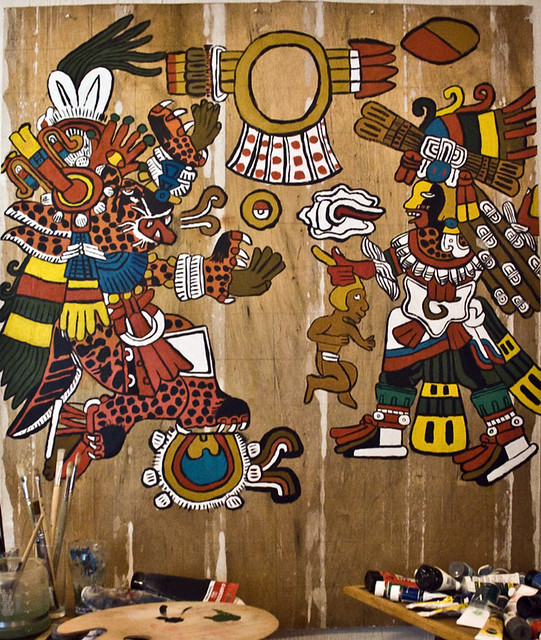
[Tezcatlipoca vs Quetzalcoatl.

Credit to Patrick Charles.]

After reading through these seven mythologies what hurts most are their implications of greater bodies of myth that have been lost through conquest, fire, and genocide, these tales of irreplaceable insight that might never be found again. But what has come down to us might yet serve as models for other value systems, other rituals, different worldly goals and heavenly rewards, showing us that the modern secular world we smugly think we know may reveal a hands-on pro-active divinity in it yet. And since that divinity is as varied as the stars are numbered, those same divinities still cast their shine & shadow through us.


#  #  #


Addenda from 9/4/2012 response to inclusion of other mythological sources:


Thanks for the praise.


Outside of Budge's pieced together interpretations, there doesn't seem to be much Egyptian source material, plus when one goes to Egypt you find out alot of the stories tend to be socio-political metaphors for Upper versus Lower Nile conflicts and resource squabbles, and more attention's focused on the dynastic legacies of the pharaohs which makes it all much less compelling, but I find their death-centric architecture & design of deities aesthetically wondrous. Just scored a Set statue this week, which is way weird because in Egypt he's really nowhere to be found, except in relief at Abu Simbel.


The Indian Mahabharata, Upanishads, and Vedic literatures just seem to be a daunting & lifetime undertaking. And where even to start such a bottomless body of study? And with whose translations? A girl recently told me a terrific story from Upanishads where a boy, via his father's offhanded dismissal, unintentionally gives his son to Yama, the lord of death. That narrative's totally my flavour of ice cream, but unsure if the overall system speaks to me on an intuitively truthful level, truth being personal and relative, (oooh, big cans of worms there. Yeah.) or it could just be it's just so outside of my cultural bias that I can't wrap myself around it spiritually. Am watching a Bollywood movie featuring re-incarnation as a central plot-point mechanism, so maybe it'll learn me something.


Right now I'm drawn again toward Norse Reconstruction, which I gather you're also curious about with your Odin post. There's some really good podcasts out there where they discuss modern paganism and the ancient lore. Ravencast's done by a well spoken East Coast professional couple who do a nice job of presentation, and Raven Radio's an unedited technical glitchfest but nearly every show there's some great perspective being issued forth from a Kindred in New Mexico with members who have completed all the serious mythology homework and aren't afraid to apply it to the now. They're all about drinking as ritual, too. Got mead?


#    #    # 


While a mostly happy bookstore fixture for over two decades, Guillermo Maytorena IV is currently willing to entertain your serious proposals for employment as a literary/cinema critic, goth journalist, castellan, airship pilot/crewperson, investigative mythologist, or assisting in a craft brewery. Should you be connected to any of the above or equally interesting endeavours, do contact him via LinkedIn or G+.

Monday, June 18, 2012

J.

Your ruminations on the world's ephemerality make me bake little sadcakes in my already diseased Triscuit-fed heart.


If the changes at work trouble me, it's because I haven't changed -- instead it has changed around me. If change is the only constant, then it's all castles of sand, existential, and striving is rendered absurd against the tides.


Yet the castles of stone stand, the temples are washed with the pure milk of faith, the blood of the fallen bear relevance, and the leaves in our books whisper words of the dead that never, ever change.


I want the castle, the heart preserved in warmest amber, a love of shining diamond, shared orgasm on a Möbius strip, consciousness indestructible, divine perspective, perfect peak apotheosis, and the forever & ever, forever amen.


A first kiss without end.


If the world is too busy eroding and dying and disintegrating in its constant change, I will write my permanence down, and one midnight someone will read my words, whisper my forevers into being once again, and raise me from the grave: whole, incorruptible, miraculous, constant.


[Guido Cagnacci (1601–1663), "Allegoria della vita umana".]


#    #    # 


While a mostly happy bookstore fixture for over two decades, Guillermo Maytorena IV is currently willing to entertain your serious proposals for employment as a literary/cinema critic, goth journalist, castellan, airship pilot/crewperson, investigative mythologist, or assisting in a craft brewery. Should you be connected to any of the above or equally interesting endeavours, do contact him via LinkedIn or G+.

Tuesday, February 21, 2012

the way of Car-Fu.

In the wake of the Wachowskis' "Speed Racer", and car-centric cinematic franchises like "Fast & the Furious" and "The Transporter", classics like "Bullitt" and "Grand Prix", or cult favourites "Gone in 60 Seconds" (1974 original) or "The Road Warrior", or "Death Race", the subversive "Drive" (2011), and grindhouse horroramotive "Death Proof", the theme of cars equipped for aggressive and offensive driving pervades and fascinates as a highway accident does rubberneckers. The guilty spectacle of cars duking it out sells tickets, but as with everything the roadtrip begins with the written word, realized to the vanishing point where death imitates art. 


Taking it back to source materials, Ib Melchior's "The Racer" inspired Roger Corman's "Death Race 2000" leading to its 2008 update, while Alan Dean Foster's "Why Johnny Can't Drive" influenced Steve Jackson's enduring "Car Wars" boardgame that later seeded Sony's "Twisted Metal" titles. Both short stories passenger us into a creepy dystopian near-future where the worship of the machine outweighs the value of an annoyingly overpopulous humanity. 


That annoyance makes itself felt on the highways, as the stories both key into road rage where lies the inevitable confrontation of ineptitude & obstacle followed by the immediate emotional reaction of frustration, a roadblock to the 1950s idea of the car as ultimate freedom and vehicle for liberation, an impedence to the "grins" as many automotive journalists like to characterize the joyride of high speeds granted by performance cars. 


In Arizona last year a man who believed he'd been caught speeding, drove up and shotgunned a photo van, disabling not only the equipment but killing the non-police technician inside. The state pulled all the monitoring vans off the roads for awhile, fearing more of the same might happen. If authorities aren't able to stay on top of it, such doubly wrong minor revolutions might become more widespread. 


With ego and identity being wrapped up for so many owners in their rides, some drivers' automania manifests in a "Move Bitch", my car is better than yours, bolstered by the false sense of unstoppability. Whether that exoskelton is 2000 musclebound pounds of Detroit steel, a carbon fiber sword cutting through the windflesh, or a drifter carving a mountain, the need for proving one's superiority on the road has the aspect of an armoured arms race. Given the exponential fast-forwarding of technology, and the widespread popularity of aftermarket kits, it may not be so far off the map that customizers could install such modifications under the pretense of personal on-the-road protection to take care of business. 


Such may herald the grim way of Car-Fu.


#  #  #


1/21/2014 Addenda: Yes! Pima County has eliminated the totalitarian speed enforcement cameras in Tucson! Hopefully this will be followed by the City of Tucson removing their financially onerous & legally entrapping intersection cameras, too!


#    #    # 


While a mostly happy bookstore fixture for over two decades, Guillermo Maytorena IV is currently willing to entertain your serious proposals for employment as a literary/cinema critic, goth journalist, castellan, airship pilot/crewperson, investigative mythologist, or assisting in a craft brewery. Should you be connected to any of the above or equally interesting endeavours, do contact him via LinkedIn or G+.

Monday, December 26, 2011

the face of Terror.

[Preface: In an unanswered email to “Speed Racer”'s Peter Fernandez, I asked if with the presence of mariachis, Spritle's sombrero and zarape-clad luck charm, the fact that the series was also simultaneously embraced as Meteoro, and Peter's ethnic background, if Speed was actually a Latino. Given that very real possibility is still an open question, I've crafted a Mexicano origin for my favourite SR character Captain Terror.] 


You knew the nature of speed the moment they passed. A swarm of deafening metal hornets tore through your village's ancient street, carrying the first heroes you ever knew. Glorious racers, fearless and formidable. The first done was the first chosen for more. The first wins over the rest, like a last man standing on a field of battle, bloody and renewed. 


Trolling outlying junkyards with your friends, you fought one another for parts to build the better racer, getting not only faster machines but stronger selves in the quarreling. Young vultures vying for the sleeker bones. It was the airplane wings nobody wanted. They could be fins, you thought, gathering them up, but even then there was the fanciful idea that if they could harness downforce, why not give the car an edge of lift at the right moments? If acrobats in their feathered caps could fly, so might cars ... . 


El Jaguar earned his moniker not only because he drove the venerable D-class, but because he'd been born with the spots on his face. He was Mexico, their pride, and he represented us in the WRL like few others. But he got drafted. Then, surprisingly, you got drafted. The rebels were blowing up arterial superhighways as fast as civil workers could make them. “Politics are one thing, but driving's another,” grumbled a corporale who ran the motorpool you had to report to. The jacket read Torres but even without the mask you knew El Jaguar, black oil up to his elbows like an ancient priest searching a chest cavity for the heart. Armoured cavalry wasn't exactly racing, but the dune buggies and jeeps always seemed to have something extra under the hood, and you learned tricks of carcatecture from Torres. All the time tearing up the back stretches growing up paid off, and your skill made you a captain of a special drivers unit. 


It was at the Paseo del Borges that the rebels set up the trap. The labyrinthine switchbacks proved fatal for some of your soldados, the mortars caught others, but you took point and drove right up the embankment at them, headlights showing the startled looks in their eyes. Then the landmine ripped the wheel right out of your hands and tore the buggy apart. "Capitan!" they cried as the concussion knocked you into the black. 


The bandages unfurled like a blinding white highway. 

Reborn. Reborn in terror. From Mictlan back into the world. The obsidian knives of shrapnel had flayed your face away, but it was nothing. You were better. And you could now see the connections: The dotted white lines, the mile markers of the soul, the secret fuel mixed in the air itself around us all, waiting for someone who knew to make it combust and push the hidden engine that turns the sky itself. The horror on the nurse's face was secondary, but in their unspoken discomfort they discharged you sooner. 


The men who were left after the attack joined your team soon after the rebels scurried back into the Yucatan jungle, and the ganga back home who still worshipped the wheel came after receiving word. The ritual fires were lit in the hidden valley. They took the mystic numbers on their chests, and stood on the cars, skeptical at best. The winds began, and they felt it: The pull of the pyramids' vanishing points, the long leveled ruins of Tenochtitlan, the track echoing the rounds of mother Coyolxauhqui Moon, and powerful fusion Tonatiuh Sun, the road on Quetzaquatl's twisting back, the cleverness flowing through chaos in Lord Tezcatlipoca's obsidian rear view mirror, and Huizilipoztli's fight for dominance. The winds stopped. They gasped as the white eagle feather fell out of the dark skies, piercing your hood on the crown as a sign of what was to come. 


The old airplane wingtips had kept well, and were easy to duplicate for the other cars. Like the acrobats, the wind held us weightless, separate, yet one. "Impossible!", they cried, scared, but also proud to have braved the chasm. After that, all the small jumps, formations, and carymids were easy enough. And with the aerial advantage of the wings, no one else could do them, though many would die trying. 


But the ultimate revelation of racing that your death gifted you was that it's not about victory itself. It's the completion of the circle, the connecting of two geomantic points, the closing of a circuit from which energy generated can be harnessed to do magic. To make the Car Acrobatic Team more than exceptional racers. To make them the heroes not only of one old Mexica village, or of a nation, but the whole world over. The magic would make them fast, the fastest ever known, and you would drive them onto glory.


[Sported this Captain Terror Car Acrobatic Team vinyl for five years.

Graphic Design credit to Joel Yohn.]


#    #    # 


While a mostly happy bookstore fixture for over two decades, Guillermo Maytorena IV is currently willing to entertain your serious proposals for employment as a literary/cinema critic, goth journalist, castellan, airship pilot/crewperson, investigative mythologist, or assisting in a craft brewery. Should you be connected to any of the above or equally interesting endeavours, do contact him via LinkedIn or G+.

Monday, December 5, 2011

the platforms of speed.


An hour of tapping holes, hot drilling, raw elbows, metal shavings, and sliced fingers. All worth it.


#    #    # 


While a mostly happy bookstore fixture for over two decades, Guillermo Maytorena IV is currently willing to entertain your serious proposals for employment as a literary/cinema critic, goth journalist, castellan, airship pilot/crewperson, investigative mythologist, or assisting in a craft brewery. Should you be connected to any of the above or equally interesting endeavours, do contact him via LinkedIn or G+.
i miss my dead dog ... so what am i?

I fucking miss my dog. I miss him so much, my packmate, Buddy Guillermosson. And the thing is I know, I know he's having a good time, ...